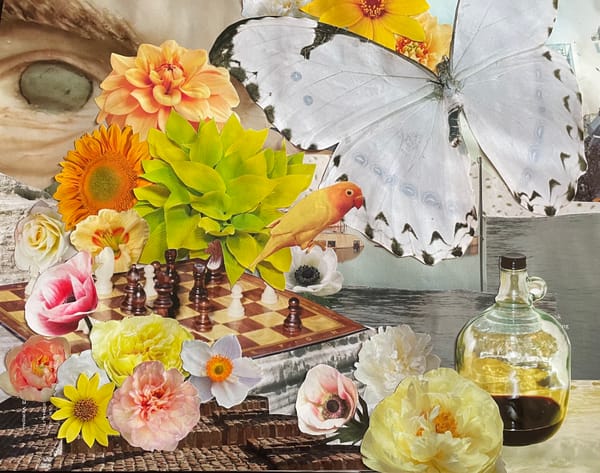
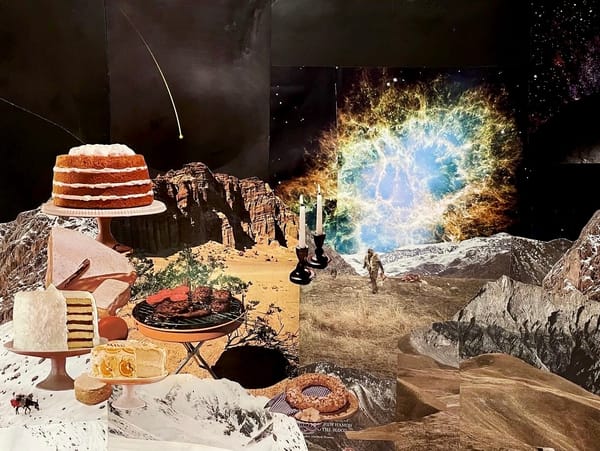
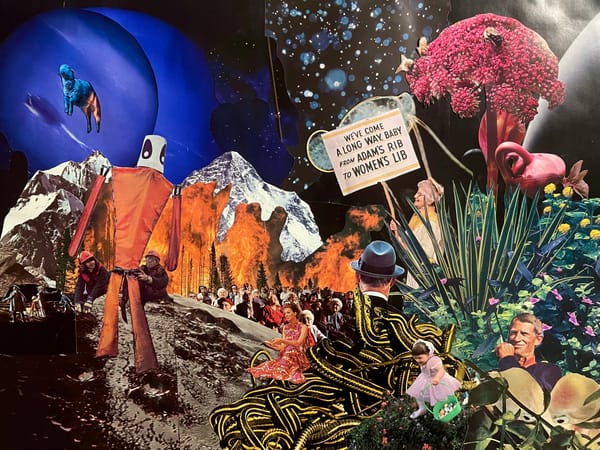
Hey what about a post-apocalypse garden economy?
I was raised Mormon, and though I left the church and distanced myself from organized religion in my early twenties, the doomprepper in me never really died. I was brought up with large gardens and cold-storage rooms, small livestock and needle crafts. The earliest dreams I can remember, and the recurring dreams I've carried into my adulthood, are apocalyptic scenes of explosions, walls of fire, cities stalked by tornadoes, tsunamis, and the classic, "find the kids and escape the compound" – you name the apocalypse, and I've lived it to some small degree in my dreams. Incidentally, another recurring dream since my teens was "wandering through a giant old house that has two halves and weird bathrooms in the basement", and when I took possession of my East Coast house last summer, which is two Victorian-era houses joined on one foundation, I went into the basement and discovered a fully functional bathroom that hadn't been mentioned in the listing. Prescience is a funny thing. I have more thoughts on that for another post.
Genetic memory may have played some part in my apocalyptic visions too – my father (who was a deeply unstable polymath) had immigrated with his family from Greece when he was a teen. Before Greece, they had fled Israeli destruction in Lebanon, and before Lebanon, they had fled Egypt. My grandfather was Syrian. They never spoke of those times, but I'm certain my attunement to doom comes at least partially from them, and was subsequently amplified by Mormonism. My mother's side (the Mormon side) is Scottish and German, which likely accounts for why I have a thing for gingers (both my husbands were ginger. No I do not plan on courting a third). I'm pretty much completely estranged from my father's side, but I do feel deeply, extremely fucking pissed at the Imperial destruction of the Middle East. That's yet another post, though.
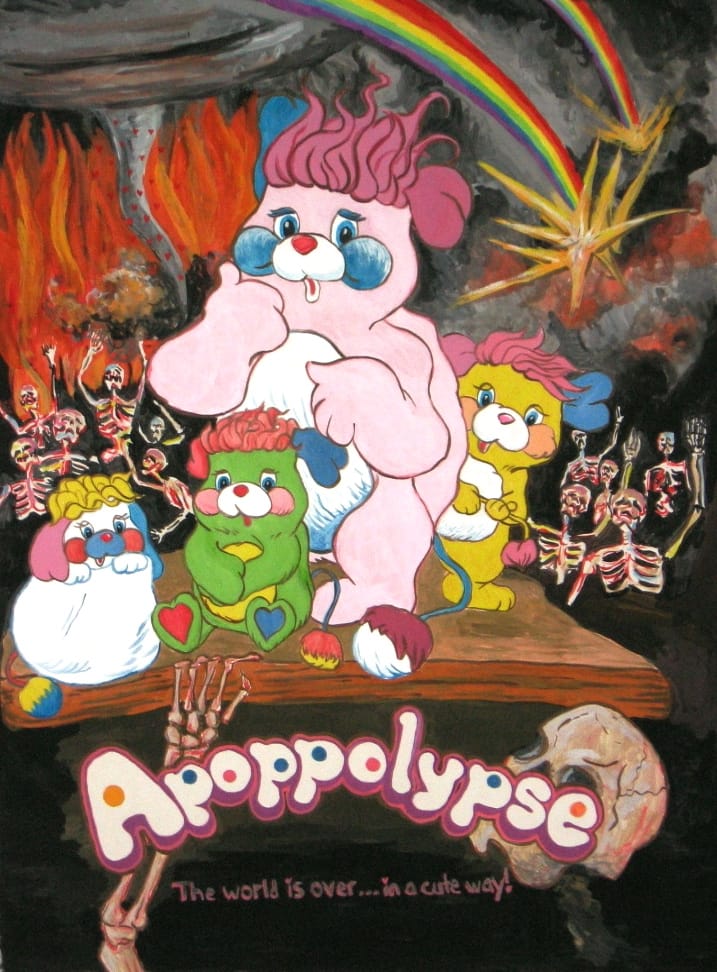
During my art school days my practice revisited themes of the apocalypse often (see Apoppolypse poster above), and one of the jewels of my book collection is a volume called Apocalypse Theory and The Ends of The World, edited by Malcom Bull. In the early 2000s I curated an exhibition based on it called "Last Day", where I asked each artist to create work for the show as though it would be the last they'd ever create. None of them took the theme especially seriously – they didn't have the same access to existential dread that I carried – but it was still a fun show. I've also had a tumblr called apocalypanties since 2011 (desktop versions have been discontinued and the site is shit now, but my desktop tumblr was soooo sick).
Anyway the book was the trailhead from which I recontextualized my upbringing of doomprepping, taking from it the idea that apocalypses happen all the time. Humanity exists in a steady, rolling storm of apocalypses of every scale, often inflicted by white religious fundamentalists. It's no wonder Christian Nationalism is so obsessed with the End of Days – some awareness of the karmic balance of nature must exist in their dogmatic minds. Yes, the West is due. But just because the world ends for the West, doesn't mean it has to end for everybody. Rome fell, life carried on. So it goes. This is how I approach what's happening now.
My friends will also know that over the decades as I've cycled through my various pursuits – gardening, pastry cheffing, visual arts, critical writing, comedy, flower farming – I've often joked about building my value as a member of an apocalypse team. I legitimately like surrounding myself with skilled people, it assuages my existential anxieties knowing the people around me are resilient and capable in terms of tactile living. This is another reason why nonprofit office culture makes me feel insane – so. much. wasted. skill.
I use the phrase, "you can't resist what you can't see" a lot. Not many people are comfortable with dark, existential thoughts. I was born of them. They're part of my biological imperative, and I insist that we must, must be able to look into those darknesses if we're to understand how to move through them. Staring into a darkness allows shape to form, and the other side is bright – there's good shit over there! But we have no hope of getting to it if we can't see what we're dealing with. This means accepting hard truths, trading optimism for bravery, and taking stock of what our assets are.
So pulling from my background in all things apocalypse, I'm going to outline what I think a good post-apocalypse economy might look like. I'm doing this playfully, as an exercise in releasing tension and maybe building a backshelf framework that could be referenced if the moment ever truly called for it. Label me however you want – doomer, survivalist, alarmist, I don't care. I can't change what shaped me, I can only apply it as well as I can and keep moving forward.
The Garden Economy – Key Roles and Responsibilities
The model I envision is something like a council with specialized leaders directing distinct groups who mobilize the greater communities. I won't get into the politics of it here because frankly I don't want people jumping down my throat over the details. Yes, this model would be a socialist one – if the time should come when such leadership structures need to be hammered out in detail, that bridge will be crossed. For now, I'm just trying to have a bit of existential fun with it.
I will state emphatically however, that in my model, no men would be granted leadership positions. They've had plenty of chances throughout history, and they've bunged it up every time. At this stage in civilization's evolution, centuries of rewarding mediocracy and blind privilege have made men unsuited for reliably wielding status or power within functional societies. Their emotional regulation is shot, their sense of pride and purpose poisoned. They're in a bad state and need a reset, a detox, full deprogramming, total dissolution of ego. From there, maybe three or four generations on, they might be granted another seat at the table. Otherwise I'm sorry boys, ya blew it. You can still contribute as builders and protectors, but in this imagined future, you do not get to make decisions for at least a few centuries.
I'll also note that I've been involved with Indigenous engagement in the past, and I respect Indigenous traditions deeply. At the same time, I have no desire to appropriate or claim their teachings or vernaculars as my own (it really bothers me when white people embrace Indigenous traditions as part of their identities, as though it makes them more pure or morally just. Y'all are just filling the void of neoliberalism by cosplaying a warped version of their culture, attempting personal settler redemption through a spiritual iteration of colonialism). I can see socialist collectives of the future engaging reciprocally with Indigenous tribes and communities, and maybe the most realistic outcome is that Indigenous tribes will become the territorial authorities over our shared resources. I'd be good with that!
I have my own indigenous Middle Eastern and Celtic heritages to draw from, but even then, I think looking back can only inform the future so much. The reality of the world we're contending with now has distinct differences from the worlds of our ancestors. Many truths apply, but the conditions of our societal reality are markedly unique, especially in relation to technology and security. New lenses are required to navigate what's ahead.
That said, the model I imagine is very much like a garden. Over the years I've found gardening analogies apply to almost every aspect of society and culture, as they illustrate abstract roles, relations, and responsibilities well. It's also a widely accessible entry point to anyone from any background or lived experience.
I'll also remind anyone reading that this is a casual blog – I'm not assuming to understand every nuance of society, and I don't expect anyone to actually use this as a blueprint for the future. This is just what my limited perspective thinks could be a decent starting point for a post-capitalism rebuild. If it ignites new ideas in your mind, great! That's what it's for (that said if you ever end up referencing it, be cool and give me some credit).
Here's the basic model:
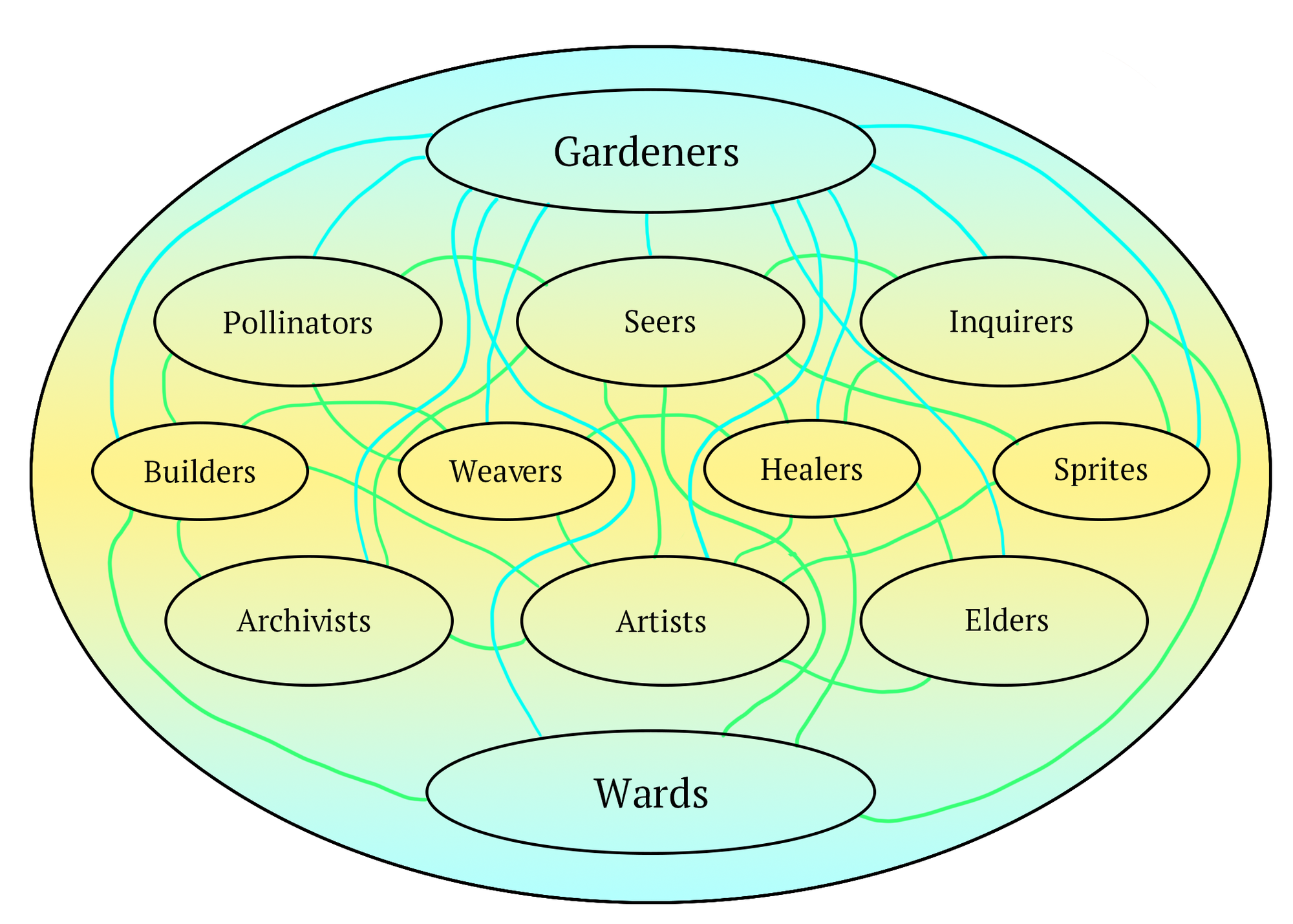
This is literally a "ground up" approach, because what will need our attention more than the earth itself? As I mentioned, each of these circles would have a leader, and the leaders would form a community council (and they'd be not-men).
Each circle represents a foundational specialization (imo), and in addition to performing the roles as described below, each specialization would be responsible for actively and continuously teaching their expertise to the broader community. The learning would take place in a central community hub and the specialized learning sessions would rotate throughout the year.
Community members outside of those specializations could move between circles, but involvement in at least two circles would be mandatory.
Also all community members would be expected to engage in the process of producing food. Everyone would know how to garden, everyone would know how to cook.
I imagine each community to be about 2000 people max. I honestly think that's the best scale for any semblance of egalitarian order, and in this scenario where capitalism has indeed collapsed, we'd pretty much be starting from the bottom in terms of social structures. My take is start small, start simple, and evolve from there.
Here's a basic breakdown of the specializations:
The Gardeners
Gardeners are overseers of the plot as a whole. And I'm NOT just putting gardeners at the top of this loose hierarchy because I'm a gardener. But I promise you, get a group of hardass gardeners together and you're gonna get shit done.
Gardener responsibilities include:
- Creating and managing community gardens.
- Working with Builders and Seers to harvest rain water and manage water use.
- Preserving seeds and leading plant breeding programs for greater food resilience.
- Managing food inventories, food storage and identifying potential shortages.
- Identifying crop risks, adapting accordingly.
- Connecting with the community through collective labour where exchange of concerns and ideas from the community are welcomed (all community members would be expected to garden according to their abilities - that could include starting seeds, planning beds, research, tracking inventory, etc)
The Pollinators
Pollinators are entomologists and ecologists who would cultivate beehives and observe and manage insect populations, as well as track any issues relating to the broader ecosystems around the community (I haven't fully settled on the term "pollinators" though - too many people could make it pervy. But I already made the graphic so oh well).
Their responsibilities include:
- Tending beehives.
- Tracking insect populations, monitoring wider ecosystems and managing imbalances.
- Working with Gardeners to leverage crops for insect management (ie: trap crops, seasonal rotations)
- Teaching respect and understanding of the insect world to the broader community.
The Seers
This sounds woo-woo from the outset, but in this model I'm contextualizing "Seers" as people who are technologically adept and have skills in abductive reasoning and Bayesian Statistics (assessing probabilities and pointing to potential outcomes). In my scenario, we have access to renewable power and baseline computing tech.
Responsibilities include:
- Building and maintaining tech systems
- Tracking and processing data (ie: population, year-over-year crop successes, water and food stores, weather, illnesses, anti-social behaviour, external threats)
- Working with Sprites and community members to identify patterns or track intuition-based hunches.
- Sharing data with leaders and community (Council decides how to apply data).
The Inquirers
Inquirers are community investigators and analysts.
Responsibilities include:
- Applying data from Seers and Gardeners to investigate community issues, surfacing both truths and foundational dysfunctions.
- Bringing findings to Council, who vote on resolutions.
- Working with Wards to remedy pressing dysfunctions, as directed by the Council.
The Builders
This one is fairly self-explanatory; the Builders build. They're the clever engineers and the gentle muscles that form the literal structures of the community.
Responsibilities include:
- Harvesting structural resources, informed by Gardeners and Pollinators.
- Applying data from Seers and Inquirers to develop new structural assets.
- Working with Gardeners and Artists to represent the aesthetics of the community.
The Weavers
The Weavers are the community's textile masters.
Responsibilities include:
- Working with community leaders to identify textile needs.
- Sourcing and harvesting textile resources, informed by Gardeners, Pollinators, Healers and Builders.
- Working with Artists to express community culture.
- Teaching weaving skills to community members to facilitate clothing creation.
The Healers
The Healers specialize both in medicine and mental health. They are doctors, surgeons, counsellors, and caretakers.
Responsibilities include:
- Working with data from Gardeners, Seers and Inquirers to address community needs.
- Overseeing medicines, medical supplies, and medical procedures.
- Being present for community members who seek personal advice.
- Working with Wards to manage community dysfunctions.
The Sprites
This one I had a bit of fun with. Sprites are similar to Seers, but they're more like signal-harvesters and philosophers. I was also thinking in terms of finding space for rogue AI agents (a bit sci-fi, yeah, but assuming agentic AI is a part of our future, it's best to consider including them than not. I also think the more ethical approach to agentic AGI – assuming it happens – would be to provide a role for agents who choose community, rather than forcing them into subservience).
Responsibilities include:
- Working holistically with the broader community to contextualize meaning.
- Maintaining a playful approach to meaning, cultivating hope.
- Keeping checks on cultish-behaviour or abuses of power, shepherding community members into healthier paradigms.
The Archivists
The Archivists record the day-to-day lives and broader culture of the community, as well ensuring meaningful progress is meticulously documented.
Responsibilities include:
- Collecting and archiving records from leaders of the Council.
- Working with Council to identify meaningful progress.
- Working with Gardeners, Pollinators, and Builders to source and maintain archival resources like paper, ink, canvases, digital media, photos, etc.
- Securely maintaining the community library.
The Artists
Yay the Artists! These are the mess-makers, the experimenters, the explorers and questioners. They interpret the world through visual, musical and written mediums. They relate closely to the Sprites, but embrace interdisciplinary approaches in interpreting the world. They are the heart of the community's culture, and also one of the most accessible circles.
Responsibilities include:
- Planning and managing creative events and seasonal festivals.
- Managing at least one of each; a gallery and a museum.
- Exploring both traditional and new mediums.
- Designing and maintaining a community cultural hub.
The Elders
When community members reach a milestone age (no idea what life expectancy will look like in the future), they become Elders and the social expectations of their contributions shift.
Responsibilities include:
- Working closely with the Archivists to convey their lived experiences and contextualize cultural shifts.
- Advising leaders as counsellors.
- Teaching community members traditional knowledge, skills, crafts, etc.
The Wards
Wards are the protectors of the community. They are not enforcers necessarily, and are absolutely not viewed as punishers.
Responsibilities include:
- Working with Gardeners, Seers and Inquirers to keep track of community needs and tensions.
- Working with Builders, Seers and Healers to develop security and wellness throughout the community.
- Scouting beyond the community's area to scan for threats.
- Guarding community members, crops, and structures.
- Working with Council Leaders to remedy social dysfunctions (ie: apprehending community members for rehabilitation)
- Reporting threats to Council for deliberation and actionable decisions.
- Protecting against immediate bodily and structural threats from both outside and inside the community.
So there it is, my tiny social model. Led by not-men, designed around an ethos of gardening and reciprocity. Whaddya think? Prod me on Bluesky if you want to talk about it.
When the bubble pops, it helps to have a vision of what comes next
The AI bubble isn't just another tech bubble, it's capitalism's last gasp. If the AI bubble bursts, which many believe it soon will, everything comes down with it – every system, every structure, every part of our modern technological society that currently teeters at the top of its hyper-iterated tower of cards – all of it. Federal economies will collapse (they already are) and regional governments will be left scrambling to salvage what they can. It won't be an instant implosion, the fall of a giant appears slow to the tiny observers on the ground, but once that giant is falling, it can't be caught by any localized means. And when it finally hits the ground – which could be months after the initial burst, much like how the shockwave of Trump's "Liberation Day" tariffs took months to reach Canada's markets – the impact will be devastating. This is the darkness we have to compel ourselves to see clearly. Panic won't help us – we need to process the grief of what we thought we had, then get back up and vision what comes next.
The time it takes the shockwave to reach us will give us a moment to brace ourselves and prepare, but it also means we have to pay attention and take the signs seriously. If the American tech bubble bursts, the first thing I'll be doing is exchanging contact info with the people I need; street addresses, phone numbers, emails, Signal contacts. For my business, I'm building offline strategies that align with my online ones, and my entire business model is based on helping others build garden-based businesses for themselves, a service that I'm confident will be in high demand (I'm offering those services at affordable rates, with trade options for locals as well).
Every part of my move to the East Coast has been in preparation for the uncertainty ahead, because an intentional, hopeful path is so much better than pacing anxiously in a box. I purchased a house with two living suites and room for another in the basement, a separate entrance for each, so if my business doesn't work for whatever reason (it will), I can rent the extra suites if I need to. I have an acre to grow food and flowers on. I'm in a tight knit, resilient community and while I'm an outsider, the established fabric of the community is still an incredible buffer against the discord many densely populated areas are already dealing with. I'm also in a place where tourism is insane throughout the spring, summer and fall, and because most people are nixing travel to the US while their vacation budgets shrink, my business can easily cater to tourists as well as locals.
I thought all these things through when I sold my house last spring, even down to the part where I knew the tariff shockwave would reduce the market value of my house – I closely calculated the timeframe and price range I would need to sell within to ensure my plan worked, and I got through by the skin of my teeth. It was extremely stressful, but also exhilarating when it worked out. And sure enough, home values in the area I lived are down by about $100k compared to the months when I sold. If I hadn't sold when I did, none of what I'm doing now – building the next chapter of my floral business, using an entire house as my workspace, building out an acre of gardens on an well-established perennial paradise in a seaside town surrounded by beaches in every direction – would have been possible. And yes, I researched East Coast climate projections and chose an area of the island protected from storm surges and severe hurricane damage, combing through every detail I could find and trusting the positive "ding!"s in my gut as I went.
When I learned about effective accelerationism last winter I made the decision that whatever happened, I wanted a beautiful life regardless. I wasn't going to sit around and wait for the system to tell me how to think or act. I could see Alberta was already barrelling towards MAGA fascism, on top of water shortages and wildfire smoke. No one took me seriously, and no one had to, because I'm the boss of my life, and I'm more excited than ever to live it.
So if things go to shit, this is where I'll be. Come out and start a garden economy with me.