The curse of powerless pattern recognition

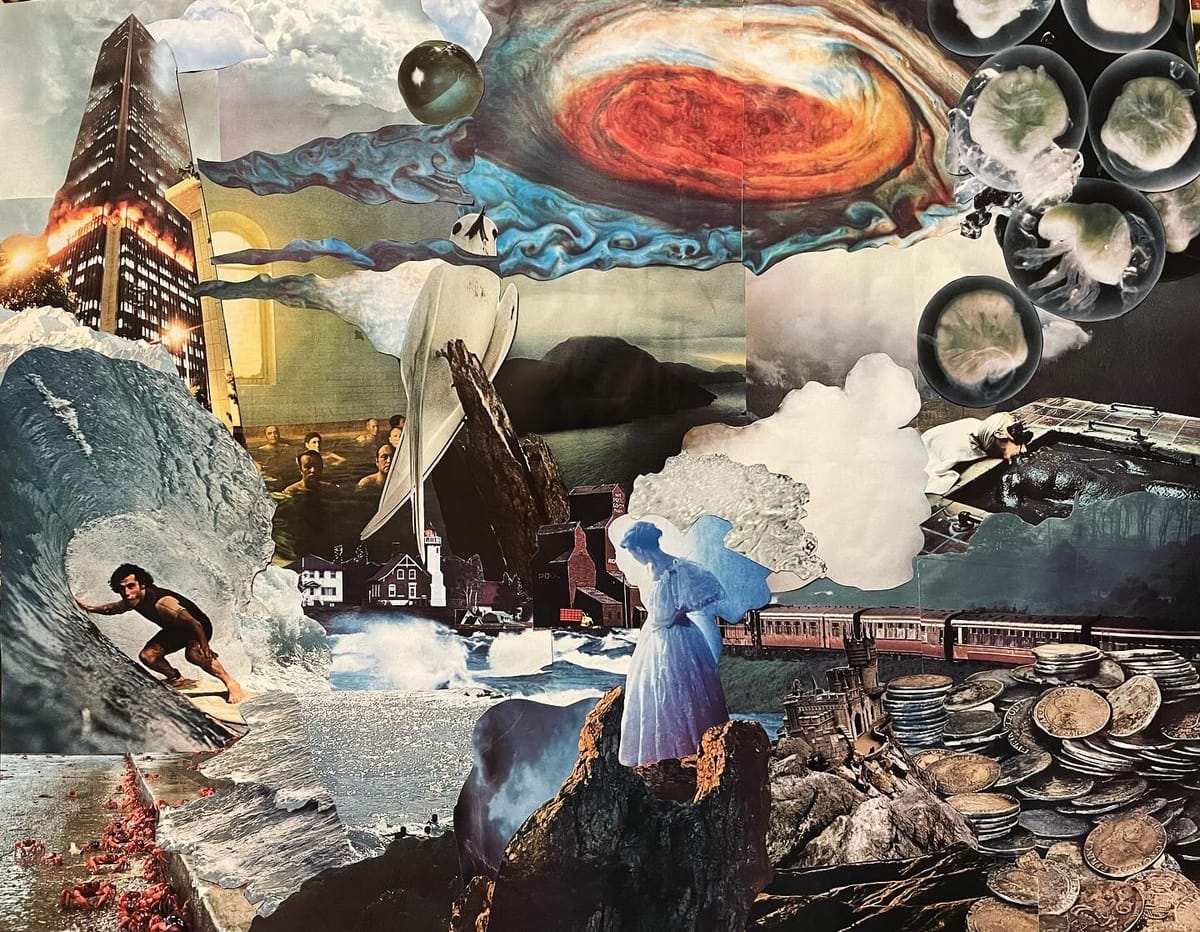
About fifteen years ago I casually started warning my circles that once the speed of information outpaced our bureaucratic systems, society was likely to collapse. I remember mentioning it at a family dinner as we lightly engaged in "what's wrong with the world these days" conversation. My family is actually great for musings and speculation, for reasons I'll get into in a bit here, but my perspectives were still too abstract to be considered seriously. Fair enough, no one took anything very seriously those days.
In 2010 I also warned we were making ourselves cognitively vulnerable by outsourcing to digital media, ie: "after spending 50 years transferring all of our knowledge onto our infinitely precious world wide web, [what if] suddenly none of our power outlets are any good. Plugging in will be spotty at best, and our bank accounts, social lives, collective histories, memories, educational whatevers... all unavailable."*
That warning also included, "I'm pretty sure that our achilles heel is the internet. The more we convince ourselves that we need it to live, the more we will need it to live."*.
I spent a lot of time telling people social media was "a dangerous social experiment", while also staying close to the beast itself because, a) it was fun, and b) if you can't beat 'em, just watch the decades-long crash in slow motion while trying to encourage awareness along the way.
Here are a few more examples of the warnings I made at least once a month:
2010: "there is a NEW PRIVACY setting called "Instant Personalization" that shares data with non-Facebook websites and it is automatically set to "Allow." Go to Account>Privacy Settings >Applications and Websites > Instant Personalization, and uncheck "Allow". BTW if your friends don't do this, they will be sharing... information about you." - I was right
2011 (re: feeling the urge to post): "is this a symptom of exhibitionistic narcissism or just needing human contact?" - I was right
2016: shared, "The presence of outrageously fake news on Facebook may even remind users of this, that what they are seeing is an entertainment-oriented reflection of the world they would like to see and believe in, not the world as it is." - I was right
2017: "social media sharing and raging helped Trump by emboldening and empowering anti-liberal trolls, let's learn from that and resist taking the same bait." - I was right
2017: "Don't know how many times I've said "social media is a messed up social experiment and we're all suckers" but this backs me UP. Psychometrics and “behavioral microtargeting” are real and we're all dummies. Stay aware and critical of what the algorithms are feeding you. I mean, don't be paranoid, but also, be preeeetty paranoid." The term “propaganda” has been replaced by “a behavioral approach to persuasive communication with quantifiable results.”" - I was right
2018: re: how social media interrupts our perceptions of time: "we're FREEZING all these moments in time. We're curating our online realities (that most of us are fully invested in) with these frozen moments. And not just moments. Thoughts. Arguments. Bursts of passion, compassion, joy, despair."
... "And long after the moment has passed for us, we're pulled back in with every like, comment, or share. Even weeks after we think those moments have been resolved and archived, we're reeled back in by new reactions. We become chained to those moments, accidentally defining ourselves by passing musings."
..."a five minute video feels like a journey, you spend an hour trying to articulate a tight response to a tweet, a simple comment starts a chain reaction that steers weeks or months of your life. Online time feels a bit like "dream time", where a moment can feel like years. And then suddenly you're a decade older, and you can't remember what you were doing five minutes ago." - I was right
2019: "Social media is ruining democracy/elections via memes. I sound like a grandma here, but here I go" (more on my other blog) - I was right
2019: "These platforms have been rejigged, hacked, gamed, whatever... to serve capital or political interests, and the "freedoms" we once had here simply no longer exist. We're data. That's it." - I was right
2020: "Because social media is mainly about data mining, I've started thinking about these platforms as "the mines", ie: "how much time should I spend in the mines today", "hm who's yelling in the mines this morning", or "yikes I've been in the mines too long"." - I was right
2021: "If social media platforms are now populated by about 50% bots (that can rarely be distinguished from humans), and those bots are actively swaying not only consumer culture, but politics and policies... we're basically already living in an AI controlled dystopia?" - I was right
"AND MARK MY FRICKIN WORDS: There's an online collapse/reckoning coming where the bubble will burst and the real world will pay heavily for it. It's gonna be fuuuuucked up." - I was right
2024: "Guilt and shame are demotivators. They are tools that can be used effectively to stop bad behaviour but they are not effective for encouraging better behaviour. If used to prompt better behaviour, they do the opposite."
"Apply this to the past two decades of social media/social justice and you might start to see how we got here. How quickly we formed silos, which rewarded binary thought, which enabled "us vs them", which exploded into the clumsy wielding of guilt and shame as a "weapon for good". It didn't work."
"A political spectrum can only maintain nuance and grey shades if we can speak to each other without defaulting to guilt and shame. Find a way to desilo and deprogram binary thought, whatever that looks like for you. (Hint: get offline)" - I was right
Not long after that last post (and after sharing several more along the same lines and starting my other blog) I deleted my Facebook account and have been working on exiting Instagram since (it's harder because my small business is there). It's taking longer than I thought to leave the platforms entirely, and a part of me feels like I'm on the sinking Titanic trying to get as many people as I can into lifeboats before it's too late.
But what do I know
I was a divergent art school brat. A "manic pixie dream girl". Before that I was a professional baker (I won an award for excellence in pastry arts and ran a small, successful cake business for a short time), then graduated art school and became a practicing visual artist (I was in the Alberta Biennial and exhibited across Canada for a few years), a critical writer (I covered contemporary art for a national critical website and was published somewhat regularly), I worked marketing & communications jobs for the arts and tried standup comedy (I was voted "Best Local Comedian" in 2012 and was runner-up the three years following), and eventually became a flower farmer (I turned an abandoned homestead into a profitable flower farm and wrote a book about it which has sold over 10,000 copies). When my coparent died, my full attention turned to my kids, and I spent the following years doing strategic communications in a nonprofit office environment. I'm still shook by nonprofit office culture and might write more about it, I'm just not sure that would be wise given I still work at said office (part-time remote now, which helps me breathe).
But what do I know about patterns? What do I know about psychological vulnerabilities and the cognitive risks of digital media?
Well.
My dad was a gifted person, artistically, linguistically, academically, charismatically. He was also a Middle-Eastern immigrant who navigated heavy racial stigmatism. He channeled his anger into bodybuilding, and in his late teens began winning competitions, at one point winning "Junior Mr. Canada". When my sister and I came along (followed later by our four siblings), he was heavily involved in the bodybuilding community, managed a gym, and was obsessed with both becoming an American and becoming a movie star. He went to auditions frequently (and put me in auditions, I remember auditioning for a Jell-o commercial and for Degrassi Street). He was also physically and emotionally abusive, and after losing his job at the gym, was unemployed for about five years. We survived on the church's social services. He eventually convinced someone to invest in a business idea of his, which tanked and compelled him to abandon the business partner with the debt, while he moved our family across the country and legally change our last name.
When I was 11 my mom and us kids were rescued from him by my mom's family, but that isn't the story I'm going to tell here. There's a lot to say about my childhood, but what I'm pulling from it for the purposes of this piece, is that he had many gifts that cognitive disorder (resembling megalomania) ultimately undermined. He believed he was a literal prophet of God and spent a lot of time making predictions of the future. He remarried five times, refused any self-reflection that may have led to diagnosis or treatment, and now lives homeless in Los Angeles where he moved to be "discovered" – ever-convinced of his entitlement to fame and status.
My sister and I were the eldest – she's just over a year older than me. We were polar opposites in terms of how we internalized our childhood experiences.
She also had a head injury from a fall as a baby, which we suspect had an impact on her impulse control, which looked like amped up adhd and a long series of terrible choices, ie: as a teenager, "borrowing" family members vehicles without asking and without a drivers license, getting into physical fights often, an early fascination with terrible boys, lots of drinking and drugs...
Yet, all that while mastering multiple instruments and being voted "athlete of the year" every single year through middle school and high school. The girl was fast. She processed information faster than any system our small rural world was capable of accommodating. One time I broke the school's long-jump record, and my younger brother told me they later changed the record to my sister's name, because they assumed someone must have made a clerical error. Ha.
She was also gorgeous. Dark skin, black hair, delicate bone structure, elegant, striking features, naturally fit and toned – a Persian queen. She leveraged her beauty assertively and for quick rewards, which ultimately took her down a dark path of prostitution and drugs. She got into New Ageism, decided she was psychic and started spinning fantastic conspiracies about alien races. I remember her explaining it to me and I asked, "so, Scientology?", she hadn't heard of Scientology but was peeved there was already a framework for her ideas. Then she decided cats were aliens, and that each of us were descendants of different alien races (she insisted I was from an anti-aging race, I can't remember what she called them). Eventually she reached a point where she couldn't care for herself or her son, and interventions happened which involved police, child services, frantic family, etc.
She was eventually diagnosed with schizoaffective bipolar disorder and was involuntarily institutionalized more than once. She's now institutionalized in a Winnipeg women's prison.
Before she spiralled completely, she hassled me constantly to "heal" my relationship with our father (she tried very hard to have a relationship with him, their psychoses feeding each other), but I had made up my mind the moment we were free from him. I'm sure he's the reason for my lifelong, recurring "anxiety escape" dreams, and is absolutely the reason for my general anxiety and distrust of men. My feelings about him haven't changed over the years, outside of a light sense of forgiveness, but still no desire to speak to him again. I've never felt guilty about it, it's always been a clean choice.
But my sister wouldn't accept that choice, and it became a growing tension point between us; as I experienced successes along my winding path (and shared much of it online), he observed from a distance, then pressured her to connect us. I honestly don't know how many times I've blocked him on various channels, probably almost ten by now. It's also why I've been more cognizant of online privacy than most. It's been about 35 years since I saw him, and the most recent block was about a year ago – he emailed me through my business account trying to guilt me into sending him money.
So I have some grasp of what cognitive disorder looks like when intuition takes the wheel and tosses insight and analysis out the window. I know quite well what its risks are, and for most of my adult life I've carried a deep dread that I might be carrying some latent mental illness; delusions of grandeur, fantasy-escapism, paranoia, toxic rabbit holes and dangerous thoughts. I love playing with "big" ideas, but I do so with caution. Watching the decline of my dad and then my sister, it's also why I've never touched astrology or religion since. It's why I withdraw from positions of public influence. It's also why I care about the risks of digital media.
Whatever "giftedness" is, it runs in my family. My five siblings and I can do just about anything, as long as it's our choice and it's something we care about. We intuitively resist homogenizing influence and approach every problem from a perspective of divergence.
And there is no term more irritating and useless than "gifted". The closest our system has come to addressing it is via educational "gifted programs" that are essentially designed to corral brilliant divergent kids into the neoliberal paradigm of capitalist productivity. Of the adults who emerge from those programs, many end up eventually diagnosed with psychiatric disorders, some end up in prison, and almost all end up depressed, anxious, and voluntarily underperforming. The standardized markers for giftedness are IQ tests, which are shallow, incomplete matrices for measuring intelligence. I'm 140 good at taking IQ tests.
And as an aside, are we all just going to pretend those programs aren't actively destroying bright divergencies by forcing them into the demented boxes of neoliberal systems? Gosh, nothing to see there. I actually feel lucky we were too poor and stigmatized to be considered for such programs. I didn't find out I was formally "gifted" until my 40s, because I had established a string of diverse and somewhat exceptional achievements in my life yet continued to feel wrong and broken, so I went for therapy and got assessed. Learning more about my brain helped contextualize my path, but it may have also amplified my feelings of existential frustration with how fucking stupid everything is.
My personal position is that giftedness comes down to time perception. I think people perceive time differently according to different receivers within our central nervous systems, and "intelligence" is largely determined by alignments or discrepancies in how those receivers process time, ie: some people perceive time more slowly as though in a sort of constant state of time dilation (which can be caused by adrenaline, cannabis, LSD), which means they have "more" time to process and react to information and stimuli; and some people perceive time more quickly, meaning they have less time to react and process. This is why some people appear fast and some slow – I think we're all literally moving through time differently. I mused about this idea in my other blog too, and when I first wrote those ideas, I searched online and couldn't find much about correlations between intelligence and time, but today search results are showing all kinds of studies that back it up – cool! Here are a few studies. They don't refer to giftedness explicitly, just intelligence, but it would make sense if giftedness was just existing in a state of frequent (or constant) time dilation, plus having healthy enough neural mechanisms to process the information efficiently.
Great. So what?
This is where the curse part comes in. A lot of people assume giftedness must be such a blessing and anyone not taking full advantage of their gifts is a lazy shitbag. "If I could sing like that...", "if I was smart like him...", "if I could do what she does...", and if you're cute on top of it? Forget it. Anyone finds out you're cute and gifted but not wildly successful?? – get ready to be resented for no reason by literally everybody. Unless you get popular/famous of course, then all that resentment instantly morphs into fawning sycophancy (which I've experienced as my respective endeavours succeeded). Until you step outside of their idealized vision of you of course, then you can go back to burning in hell.
I've always considered popularity and fame a prison for those reasons, and I've wondered lately if that isn't why so many women step into their potential after middle-age. Emotional maturity lends well to navigating those issues, and society's expectations of mature women are extremely low. A late start is also the result of obvious factors like mothering, but I think for women who carry bright potential yet were never taken seriously in their youth, life after 50 is the good shit, assuming you're lucky enough to make it that far with cognitive abilities intact. Barriers include: gendered social expectations, lifelong infantilization and sexualization, fewer academic opportunities, constant harassment, choosing between financial security (partnership) and independent autonomy, an entire neoliberal framework of "contribute to the economy or stfu", the stigma of "crazy" when those barriers push you to the edge, and now we have added barriers like cognitive decline caused by digital media. Whoopee!
It's not a lot of fun to be an intelligent woman navigating the age of redpilled sexist smoothbrains. I carry an anxious whisper in the back of my mind that witch-burning might someday return, especially as the masses become fully dependent on the tools they've offloaded their cognition onto, tools that could sway their beliefs with the simple adjustment of an algorithm (which they already do, btw).
But when I see a signal, I can't ignore it. I stash it in my mind like a puzzle piece. This has been my mode for most of my life. So I find myself trying to tread as lightly as I can while processing what feels like urgent and terrible patterns emerging.
Intuition and analysis
Lately I've become preoccupied with the science of intuition, especially this article, Pathfinding: a neurodynamical account of intuition*, which I've mentioned in a previous post. I also mentioned that I'd found that the areas of the brain described in those studies are the same areas that atrophy from use of LLMs. So yes, it follows using LLMs directly inhibits our intuition processes.
In the Pathfinding article, they talk about how the intuitive process involves intuition, insight and analysis. In a previous post I talk about the mode between intuition and insight called "optimal grip", it's really neat. I think I have a well-developed sense of intuition and insight, though I think I could work on slowing down for better analysis. I get impatient when an idea is clear in my mind – slowing down to map it all out it is hard, especially when the information feels urgent. For example, the way I write these posts; I sit down around noon with an idea and can't let go until I publish it the same evening. My experience has also shown that my intuition is frequently correct, so sometimes it's easier to lean on it without slowing down for full inspection. But with writing, I'm realizing I need to slow down and articulate my thoughts without skipping ahead, as I tend to do.
Recently while I was thinking about my dad and sister and my general fears of mental illness, I was floating around looking up studies about cognition and intuition, and came across this one: Logic, intuition and delusions: dual stream processing biases in decision-making – it stood out as another piece of whatever puzzle I'm solving:
“Dual-stream information processing” is a decision-making model that divides reasoning into two separate components: a fast, intuitive stream, and a slower, logical stream, similar to our understanding of decisions made by the “”heart”” or “”gut”” versus those made by the “”head””. For most decisions, intuition and logical reasoning converge onto the same conclusion. However, in instances where intuition and reason do not agree, there may be processing differences between healthy people and people with schizophrenia.
Healthy people show a bias toward the logical stream, prompting them to more carefully examine the available evidence. In schizophrenia, individuals may not detect conflict between the two streams and may not have a bias toward the logical conclusion. This could enable their erroneous intuitive interpretations of events to endure unchallenged, leading to delusions.
This is important information, because guess what social media algorithms do? They erode attention spans, working memory and cognitive control*. They diminish our ability to reason* and analyze. Social media literally erodes our ability to process information logically**.
I wonder if this looks like compulsively sharing memes, irregularly capitalizing words, communicating feelings via gifs and emojis, and believing there are "no new ideas" (because they can't think of any). It also looks like emotional reactivity, anxiety, and adhd symptoms*.
I think the speed of those deleterious effects likely depends on the health and vulnerabilities of each individual mind. And yes, rates of schizophrenia have increased significantly during the digital media age*.
So what seems obvious to me is that intuition without analysis is really not good for the human mind. In fact it's very bad. And digital media tools like Meta products, gps and genAI are quickly eroding society's ability to engage in analytical thinking. We know this. All the research is out, all the peer-reviewed studies are right there.
Without insight and analysis we are left with mental illness
The real kick in the nuts is that genAI is eroding people's ability to intuit as well, while gps is eroding spatial awareness and memory. With LLMs, the instant gratification of getting plausible-seeming answers erases insight from the process of intuition, and obliterates analysis.
So what happens when we collectively offload intuition, insight and analysis? Can we see why these tools could be very bad for us?
What happens to a population that has lost its ability to think insightfully or analytically? What happens when all we have left is untethered intuition?
This study, Implicit Mentalizing in Patients With Schizophrenia: A Systematic Review and Meta-Analysis, explored:
...mentalization has two systems, an explicit one (conscious, relatively slow, flexible, verbal, inferential) and an implicit one (unconscious, automatic, fast, non-verbal, intuitive). In schizophrenia, several studies have confirmed the deficit of explicit mentalizing, but little data are available on non-explicit mentalizing...
Their analysis revealed:
significantly lower accuracy, slower reaction time during implicit mentalizing in patients with schizophrenia. The systematic review found different brain activation pattern, further alterations in visual scanning, cue fixation, face looking time, and difficulties in perspective taking.
So all that to say, I feel pretty strongly that the digital media tools that have been fully normalized within our social systems are going to create an epidemic of psychosis. Information isn't just moving too quickly for our bureaucratic systems, it's moving too quickly for our social fabric.
And seeing this pattern is making me feel crazy, which is ironic, no?
Even as I pull myself out of a cognitive fog that was clearly induced by the tools I took delight in for most of my career; communications tools like smartphones and social media that ate away at my memories – memories that are only just starting to surface after having those apps off my phone for over a year and drastically reducing my phone usage...
I want to understand what's happening, my anxiety demands it. I can't have a hunch and not explore it. But I also know that a decade of intentionally seeded conspiracies have rotted the minds of more than a few people (a few hundred thousand at least), and I think as a result, a lot of people have completely withdrawn from considering ideas outside of what publicly-sanctioned channels serve them. This is hard because with the rise of neofascism, legacy media is no longer a reliable way to understand what's happening. Moderate, very online centrists and lefties seem almost unable to form original thoughts outside of what their media serves them, and the media is so safe and so shallow. Everything relates back to a podcast or a reel. It's almost like musing outside of popular information, exploring meaning or just being curious is by default regarded as "dangerous".
It shouldn't feel so dangerous to have ideas! We're capable of cognitive resilience, we can hold more than one concept at a time, and as we enter an era of pervasive surveillance and rapidly shifting systems that won't prioritize human rights the way we're used to, we need cognitive resilience to protect us from spiralling off those conspiratorial cliffs.
I really believe cognitive rehabilitation is critical right now. My journey started in 2017 when I isolated myself on a remote acreage and forced myself to learn a ton of new skills while working outside most of the time. I remember how my anxiety lifted, I told people about how different I felt out there. Then we lost my kids' dad, the grief consumed everything, and I returned to the digital realm of communications, which meant getting hooked on using the apps again. As I processed the grief I dutifully took Lion's Mane mushroom and got back into reading and collaging. By that point it was obvious how much worse social media made me feel, so at work I eventually moved social media management off of my workload, focusing instead on website work and strategic messaging. As soon as I started moving out of that cognitive fog, I was overwhelmed with critical signals, exacerbated by the fact that everyone else seemed completely unaware of the incredible risks right in front of them.
Then I moved to the East Coast, and as I've shared before, I stopped using gps and banned chatGPT from our house. My teens and I have supported each other as we wean off the last few apps, and the further we get from their influence the crazier it feels to witness the mass numbing that's happening around us.
My "digital detox" began in 2017 and continues today. But I feel like I came so close to slipping into a scary mental health mode. I'm lucky that my mom's side is full of people who stayed mentally sharp into their 90s, but I'm still extremely sensitive to cognitive vulnerabilities on my dad's side, and I'm acutely concerned about damage that might risk slipping me into dementia or psychosis.
So here I am writing everything out before spring comes. I've written 18 pieces over the past month and I know it's a lot, and yes I'm a bit isolated, yes I've had a lot of time to think, yes I'm sorting out ideas publicly and some of them are a bit much. I'm not trying to predict the future, I'm not wishcasting a dystopia, I feel like I'm standing just on the outside of a massive, noisy cloud of fog filled with people, and I'm trying to define the shape of what's coming, shouting back to those inside the cloud.
I'll never stop seeing patterns, and I don't want to! If nothing else it allows me to make solid choices for myself and my family. But as the things I've warned about over the years keep happening, it's not like more patterns don't indicate more terrible shit is on the way. I still believe there are many variables that could change the course of things, and everything is a matter of probability. Some variables are big and some are small, but I have no power to influence the big things and it's extremely frustrating. The challenge then literally becomes, "don't go crazy".
Don't go crazy as these tools erode the cognitive function of people around you. Don't go crazy as people lose their ability to trust the intelligence of fellow humans. Don't go crazy as respected talking heads on social media urge the masses to adopt LLMs, the most cognitively corrosive tech we've ever seen. Don't go crazy as surveillance expands to every smart device and public sphere. Don't go crazy as our government moves to share our private data with the US (see: Bill C-2). Don't go crazy as our government hums and haws over our digital sovereignty and deregulates corporations. Don't go crazy as the status quo dissolves and the wealthy pull up stakes to retreat to their luxury emergency estates. Don't go crazy as the entire stock market pumps every cent of equity into AI and massive, pollution-heavy and energy-hungry data centres are built in towns without consenting citizens. Don't. Go. Crazy.
And the real shitkicker cincher is, if I did completely lose the cognitive functions of insight and analysis? My intuition would continue firing on all cylinders because that's how brains work in my family. I would go crazy. I would follow the path of my dad and my sister and crumple into an old babbling lady, panicked over invisible forces I would have no ability to discern the shape of. I can't imagine doing that to my kids. The whole scenario is my worst nightmare. It's worth taking seriously, imho.