Cognitive care and the growing disparity between signals and noise

Technology has accelerated the widening chasm between clear information and muddied noise; social media and now LLMs have broadly eroded information literacy and sown chaos throughout most spheres of public discourse. Everyone is confused, most are angry, some were blissfully lobotomized by the algorithms long ago.
But our online spaces are noisy. They're like walking into a massive, crowded town hall with a large panel of speakers, the stage full of lobbyists and advocates loudly trying to get the speakers' attention, only succeeding after stuffing large amounts of cash into the speakers' pockets. The audience closest to the stage never stops yelling about what the speakers are doing and through their clamour they miss most of what is being said. Everyone in the audience is yelling, "WHAT DID THEY SAY??", "A CELEBRITY SAID A BAD THING ONCE", "LOOK AT MY CAT", "I HATE THAT GUY", "I HATE MYSELF", "CHILLY OUTSIDE TODAY", "THEY ARE KILLING CITIZENS"... more people continue to fill the hall, bringing their pets, their art, their blogs, their books – people at the very back of the hall aren't even aware there are speakers, they're just happy to people watch and maybe make some friends (or enemies. I guess some people do that too).
If you were to picture yourself in this hall, where would you be? While neofascism swells in the West, and at a time when hearing what's being said on the stage is more important than ever, what role are you playing in that clamorous space? Are we seeking signals or making noise?
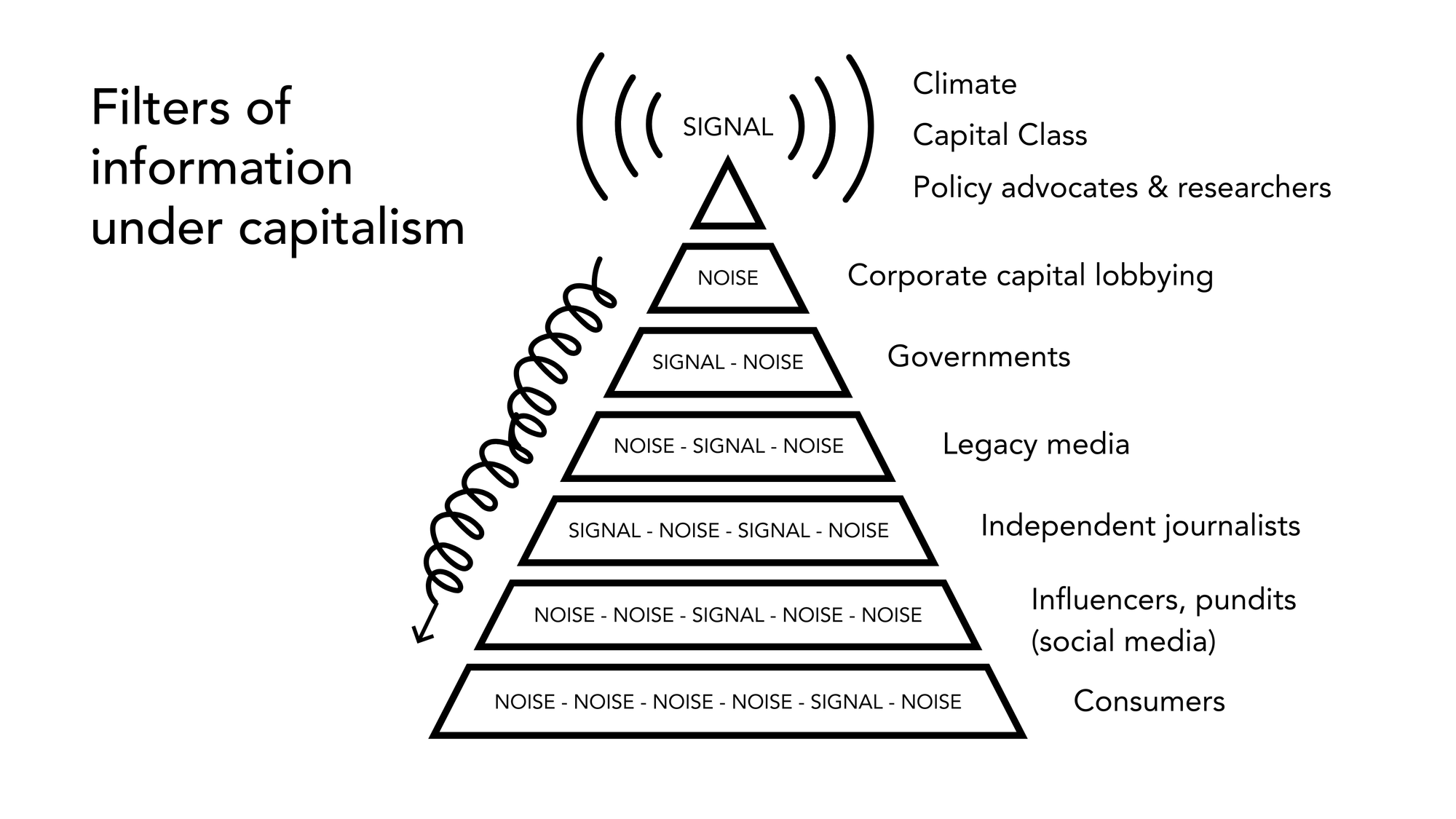
Fascism generates a lot of noise. There's also the climate, which is sending a fair amount of signals. There are government or corporate-funded advocates and lobbyists clamouring to be heard, by the governments who adopt whatever serves "the economy" (capitalists) best, who spin narratives to justify those policies. Legacy media spins whatever the governments and corporations ask them to, independent journalists push back on those spins, pundits and influencers on social media warp, reframe, and propagandize the spins; and at the very back of the room: consumers – the plebs, caught up with our day-to-day demands and hoping the voices we can hear are regurgitating some semblance of truth. We exist in noise, wading through it every time we log online. Such is the reality of living at the bottom of the information pyramid.
The graphic below is how I see information being filtered, from signals at the top to noise at the bottom. It isn't a perfect graphic, I just made it to help contextualize our present flows of information:
And while most of us are familiar with the concepts of misinformation and disinformation, few are aware of the resources that go into top-down narrative-spinning. These narratives are driven primarily by governments at the behest of corporate interests, and "spin" tends to mean "obfuscate". A feasible narrative is invented by a communications team to justify pro-corporate, anti-social policies, then boosted by all who gain from the spin and disseminated by the teeming hoards who believe the spin. One form of this might look like a government holding flashy press conferences with beloved nonprofits or public institutions, at which they announce new funding or celebrate new policies, while quietly passing terrible legislation in the background.
Fossil fuel narratives and their endless spins have been super-charged over the past four decades by rabid capitalist policies that are now embraced to the extreme by Western capitalist leaders. Rabid capitalism corrodes everything, and information is no exception. I believe we're now in a stage of mis/dis-information entropy where the noise is so thick, clear signals have become almost completely inaccessible to common citizens.
I care about this problem quite a lot. I recently came across a book review of Robert W. McChesney's Rich Media Poor Democracy: Communication Politics in Dubious Times*, the review itself was titled "Communication Should Be a Rebellious Field!"* which was all I needed to hoover the review into my brain and purchase a used copy of the book, which is now sitting on a table beside me. McChesney criticizes modern communications for its "overall trend toward quiescence and depoliticization ... providing mostly inconsequential research of little interest to anyone outside narrow subsets of the field, not to mention to anyone outside the field or outside the academy.”
In the book he states,
“When we stop speaking the truth to power, we soon stop speaking it to each other, and it is only a matter of time until we stop looking for it, or even recognizing it.”
Yep.
I've always approached communications as a sort of duty of disseminating information. I don't have a formal education in communications – I evolved into a communications professional in my early 30s (around 17 years ago) because my intuition has always demanded clear flows of communication. I've been loudly cautious about the risks of social media since 2010, and I think the corrosion of our information flows has increased dramatically since 2015. Watching this process while watching information literacy decline steadily among my peers and colleagues has been stressful. I place this blame squarely on social media, especially Meta (Instagram, Facebook, Threads). Meta products are the sewage system of information, and everyone seems to have forgotten what shit smells like.
When Bluesky launched I truly saw it as a platform of resistance; ad-free (for now) and chronological algorithms that are relatively easy to customize are two qualities that, I think, make it a superior tool for disseminating information. It blew my mind (still does) that my comms colleagues didn't embrace it when it extended beyond invite-only. I talked about this on my other blog in a post titled "Staying Sane When the World's Gone Mad: A Comms Perspective", in the post I ask "where is everyone??", and because it's relevant and you probably won't click over to that other blog, here's the gist:
If immunity to the sedative effects of social media should exist within any profession, it should damn well exist within communications. That communicators and "strategists" are still ho-humming about what open source and decentralized comms could mean for our broader systems, even now, when our comms systems are under existential threat—sends up yet another flag that we might indeed be cooked after all.
A year has passed since that post, and while a few more friends have joined Bluesky and some have distanced themselves from social media entirely, it's maddening to me that the platform is still largely viewed with skepticism by leaders and specialists who question its "echo chambers" and "leftist" user base – two propaganda points that were algorithmically filtered down to users by both X and Meta. Those "smart" people remain on the toxic platforms that exploit eroded attention spans, contribute to memory loss and cognitive dysfunction, silo users from diverse perspectives, and are founded on the rotten anti-human values of their CEOs. But sure, let's be careful about Bluesky. Not that its leadership is infallible or unbiased, but imo it's the best option we currently have for clearly accessing information.
I drives me crazy that I can't seem to convince otherwise thoughtful and conscientious people to leave Meta. It doesn't seem to matter how many times its algorithms run tests that amount to nonconsensual psychological experiments*. It doesn't matter how fractured the content becomes, how daily connections with their broader communities are progressively whittled down to a few dozen loyal engagers, how governments increasingly work with those platforms to profile users for surveillance purposes**, how AI is being deployed to dilute the fidelity of information, how calls to action are repressed through the UX, and on and on and on... it's hard to explain to smart people that they've fallen victim to algorithmic tranquilization, and it's wild to hear them insist they have agency over their feeds while at the same time justifying why they can't leave. If you can't leave, at least be angry about it.
Our society is at a critical point where localized communities need resilience more than ever, yet how much time do people spend online just consuming pure noise? As someone who constantly feels existentially short on time, the value of an hour is precious to me. So much can happen in one hour – breakthroughs, emotional processing, a garden can be built, a new skill can be learned, a random meeting at the grocery store, a great conversation, a refreshing walk, breathing, stretching. Yet so many choose the numbness of their feeds, compounding symptoms of ADHD* and worsening memory functions* while insisting they're there for "community". What kind of community steals our ability to think and remember? In what world is the cognitive cost of community so high? (this world, I guess)
A few years ago I felt a panicked sense of cognitive decline in myself. Our years of deep grief had passed, I had eliminated the brain fog of birth control (via a hysterectomy - highly recommended), and I became preoccupied with rebuilding the cognitive damage I thought those two factors had caused. I took Lion's Mane mushroom, did strength-building stretches and practised breathing every morning, walked to work almost every day, read when I could find the time and took up collaging. I went to therapy and learned a lot about my divergent brain, which allowed me to accept and understand myself in a way I never had access to before. And through that process my thoughts did become much more clear, but my memory and attention span still felt deficient. There was so much I just couldn't remember – I'd think back to my childhood and there would be nothing but thick fog. So much of my past felt like faraway whispers.
I deleted my Facebook account and moved Instagram to my desktop, and I still have a vivid memory of the day I took Instagram off my phone –it was a sensation of release, like the "clean room" feeling, but for my brain.
And then of course I immediately became aware of how utterly fucked everything was, and as I've described in another post, I quickly spun a plan to alter the path I saw ahead. We'd just gone through an extremely dark period of recovering from losing my kids' dad, and there was no way in hell I was going to let us dip back into another stretch of deep anxiety and helplessness. I decided to hit the bricks and get my family somewhere that wouldn't eat us alive through unaffordability and upheaval, and the logistics of selling our house, buying a house sight unseen, and moving across the country required a ton of my cognitive capacity. I felt stretched many times, but the plan worked because I was able to use my damn brain, coordinate, and strategize the path forward.
Now I live in a place that affords me the time to process and engage with information more comprehensively, and I've made another huge change in my daily habits: I never use map apps anymore, and as it turns out, studies show ongoing GPS usage causes hippocampal shrinkage. While I did walk to work while we lived in the city, I used GPS maps for everything else, and prior to that while I was running my flower farm, I did flower deliveries and used Apple Maps constantly. Then when we moved back to the city, my anxiety was sky high and the speed and noise of traffic flustered me easily, so I relied on GPS every time I left the house. Sometimes just to get to the grocery store – the same one I went to literally every time! I didn't even realize it, but I had fully offloaded my spatial memory onto my phone, and I'm certain it was starting to affect my other memory functions as well.
Now being on a small island where, whichever direction I drive in, I'm never further than two hours from home – I began weaning myself off map apps about four months ago, and have been completely without for about two months. I've retrained my brain to remember how to navigate, and the difference is alarmingly noticeable, like another heavy fog lifting that I didn't realize was there until it wasn't.
Mentally I've felt a sensation best compared to an OS upgrade, and it's so. much. fun. Memories of my childhood are floating back to the surface – just this morning I remembered the face of my Syrian grandfather singing the French nursery rhyme "Les Petites Marionnettes" to me, I must've been about five years old. He held his hands like puppets dancing around my head, and when the verse reached "trois p'tits tours et puis s'en vont" he made the puppets tickle my tummy. I remember giggling. A whole room of dusty memories that I haven't accessed in well over a decade is now accessible to me.
One of my favourite finds over the past couple months was a research article titled "Pathfinding: a neurodynamical account of intuition", which I've been wanting to reference on this blog for a while because it's just so fascinating, and it definitely relates here – I even took a couple pages of notes while I read it because it was just so exciting to finally see empirical research on intuition as a whole different framework for intelligence.
In the paper, they approach intuition through the lenses of evolution, neurobiology (the study of the nervous system), neurophenomenology (the study of consciousness), information-theory (quantification, storage, and communication of information) and computer science. Through experiment and analysis they frame intuition as an evolutionarily "problem solving process" involving three stages: intuition, insight, and analysis.
What really fascinated me was the "dynamical shift from intuition to insight" called "optimal grip". These are my notes describing optimal grip:
- A relaxation of high-level priors, a move toward increasing entropy - optimal grip refers to an organism’s attempt to understand and then maximize the potential benefits of all available affordances (opportunities for action) in an environment - internally generated thoughts, especially partial solutions to important unsolved problems, can be included
- Synchronization of chaos
- “To obtain an optimal grip, one first needs to relax one’s grip”
- Cognitive optimal grip does not rely on an exhaustive analysis of all environmental variables - it emerges through interaction with structured regularities— intrinsically motivated (i.e., epistemic) affordances, heuristics or priors, and salient cues—within high-dimensional and dynamically shifting environments
- “In this view, intuitive behavior reflects an embodied engagement with both environmental and internal constraints, enabling adaptive responses in computationally challenging, real-world contexts”
So cool right? That's just a small sampling of the article, but all of it was so exciting to me because I feel like it describes my whole deal. It's exactly how I approach the concept of learning and knowledge. I've also experienced how a small amount of CBN/THC oil nudges my brain towards "increased entropy" and unleashes a downpour of clear, comprehensive thoughts. It's why I've been writing so much – there are so many thoughts to play with now (too high a dose and I get too loose though, but just 1ml slips me into a mode of relaxed and focused synthesis). As I write this I'm floating along to music on my headphones while piecing these thoughts together. I think I've figured out my own little path to "optimal grip" and it's lovely.
Back to the Pathfinding article: as I read it I also took notes on which regions of the brain were identified as being involved in the processes of "intuition, insight, and analysis", then cross-referenced that information with MIT research showing use of LLMs causes atrophy to those very same regions, namely the hippocampus, temporal and occipital lobes, and the parietal and frontal cortex stating, "over four months, LLM users consistently underperformed at neural, linguistic, and behavioral levels".
Maintaining our sense of intuition depends on those regions of the brain performing well, and LLMs cause them to atrophy. By offloading cognitive work onto LLMs, we are numbing our evolutionarily ability to disseminate signals from noise. That's quite a trade-off for a novelty tech we got along just fine with for literally all of human history.
I've had a lot of quiet time in my own thoughts this past month and I'm embracing it while I can, and there are honestly days when I'm reading and an insight forms, and I swear I get a warm glowy feeling in the front of my head (even when no CBN/THC is involved). I just love absorbing information so much right now, and I'm becoming much more sensitive to information fidelity than I was before. Like when you haven't had junk food in a long time and then you try it again and it tastes like literal garbage? That's what looking at Instagram feels like now. Pure noise.
So I'm focused on seeking clear information, clear signals and clear channels. I'm collecting new (used) books, and I've curated reading lists that revolve around the root causes of my bigger anxieties; ie: neoliberalism, the media's role in democracy and fascism, democracy's role in capitalism, and the nature of communications.
I maintain my Bluesky feed actively, removing or muting accounts that generate too much noise and doing baseline background checks before following new accounts. I block bots, suspected bots, and trolls as soon as I see them, and when I first joined the platform I subscribed to block lists run by a user who has proven to be wonderfully reliable at filtering such accounts.
Way back when search engines first got really good and trusted information was easy to find, I was the sort of person who'd pass up a night out to stay home with a bottle of wine, dropping myself into online rabbit holes of information. And honestly I still love being on my computer. Not my work computer (ew), my personal computer; the digital realm I designed for myself. I'm sure I'm not alone when I say I've met countless awesome people online over the years – it's where I've explored art and shared ideas, and truly I've learned so much from internet resources like Wikipedia.
New search engine AI summaries are an abomination, imo. My favourite part of Googling something used to be finding information with depth and context that spawned new journeys and curiosities. I could spend hours just bumping around, discovering cool shit and joking with the people I met along the way. I couldn't believe we had the gift of so much information at our fingertips, for free!
AI summaries are like candle snuffers in terms of inspiring educational journeys; they're frequently inaccurate, and they're extremely vulnerable to corporate manipulation. And yes you could argue there are still plenty of websites and resources accessible in the search results below the summary, but data would argue that those user habits of exploring results below those summaries are fading quickly*. I don't want to get into the concept of enshittification* in this post (and that term makes me cringe), but that's what's happening to Google and most search engines right now. Plus every other digital public space. And it's not accidental. The imbedding of LLMs into every platform possible is a movement centred on gathering as much profiling data as possible for the purposes of data-driven law enforcement and "national security" through coming climate crises, with the convenient side effect of tricking people into offloading their cognitive agency.
So now I actually use Bluesky's keyword-based search function more than I use Google. I can quickly find peer-reviewed research, cross-check authors and find news reports I missed, and using keywords I can instantly see how those issues are being reported on in other Western "liberal democratic" countries. It's honestly really fascinating and super useful in terms of sorting patterns. Search a corporation or area of interest and the results appear in feeds differentiated by popularity and "latest" filters (and a couple others but those are the most useful). News articles and commentary will show in the results and from there it's easy to scan for clear signals vs noise. For example, I searched "agentic AI malware" yesterday to find if comparisons between agentic AI and malware were valid, and I found tons of great information with citations, research, expert commentary, and yes, agentic AI is essentially malware architecture.
For now, Bluesky really feels like a place where people who love to think are flocking, and it's very possible this might be the platform's informational golden age before LLMs deteriorate the minds feeding those flows. For now, it's sort of a sanctuary for the cursed Cassandras – the people who saw fascism coming and were labelled hysterical alarmists. It's nice to feel seen there.
I never scroll mindlessly anymore, because I only follow accounts that send clear signals, and if one starts sharing too much noise, I mute or unfollow. I do get overwhelmed with the information sometimes, and in those moments I zoom myself out and reassess which information I want to prioritize, then I scan my feed using my own filters (in my mind).
For example, lately I'm keen to know when Carney's government pushes new bills or policies, because I want to see how closely those bills and policies do or don't align with Trump's (spoiler: they do). Through my feed and the search function I've found reports by policy advocacy groups, recent news articles and analyses by smart people like this guy, who dedicate their neurodivergent hyper-focus energy to tracking such things. And then I peek at who they interact with, and I find more intelligent people who offer insights and perspectives that add context to my original curiosities, expanding my understanding of the issue in a holistic and really satisfying way. I don't take anything at face value, because we all contextualize things a little differently, but it helps me solve the puzzles in my mind more comprehensively.
In terms of what I post, I'm cognizant of how easy it is to become background noise. As soon as your audience associates your account with "noise", you've lost your ability to communicate efficiently with them, and rebuilding that ability takes time, which further disrupts the efficacy of your communication efforts. If you've been posting just for the sake of posting, or because you feel obliged to for whatever reason, and then come across something urgent that you really want people to see, it's much harder to make it stand apart from your regular stream. For this reason I care very much about my posts not contributing to the clamour.
Information literacy means being able to discern signals from noise. It means seeking information as close to the original signal as possible, and ensuring that information isn't just noise dressed up as a signals. It means following accounts with clear intention and muting, unfollowing or blocking diligently. It means reading the whole article before you share it, and then deciding whether the content is worth sharing beyond the headline. It means judging for yourself whether headlines and captions are honest reflections of the content they present, and calling posters out when it isn't. Getting out of clickbait habits is hard for communicators who've been conditioned by all those damn professional development conferences.
Information literacy also means tending to your cognitive wellness, which includes avoiding atrophy-inducing tools like exploitative algorithms, LLMs and GPS. In my opinion using LLMs for any phase of writing or research poses risks to your cognitive health, and I worry this proliferation of casual use will lead to an epidemic of early onset Alzheimer's in the near future (note: after publishing this I looked up whether early onset Alzheimer's was on the rise – a 2020 report from Blue Cross Blue Shield showed that between 2013 and 2017 rates increased 373% in the 30 to 44 bracket, 311% in the 45 to 54 bracket, and 143% in the 55 to 64 bracket, citing one possible cause, “57% of individuals with early-onset Alzheimer’s disease filled an antidepressant medication the year prior.” There was no mention of social media use, but no studies showing social media's effects on cognitive atrophy had been performed yet, and as it turns out, it very much does have that effect. Further studies show those rates continue to rise. Like what the fuck why isn't this a public health emergency?? Also probably worth reading this study titled Understanding Digital Dementia and Cognitive Impact in the Current Era of the Internet: A Review). Cognitive degeneration is truly one of my worst fears, I can't imagine living without a functional brain and it boggles my mind that so many are playing with that fire so carelessly right now. I mean, speaking of "noise", AI boosterism is probably the most chilling propaganda amplification I've witnessed.
And if you're a communicator, your skills will be badly needed in the coming years, even as organizations and businesses replace them with AI. I'm not being hyperbolic when I say society will desperately need people who can find patterns and problem solve, and it won't be long before the cognitive level you're currently at will become rare and quite valuable. Keep choosing to upgrade, reject cognitive downgrades. You will need your whole brain to navigate the noise ahead.