Normalizing social media addiction doesn't decrease its costs
When an entire population is addicted to the same thing, where does rehabilitation even start when every institution is a pusher and every person an enabler?
The field of psychiatry has yet to formally diagnose "social media addiction", and when I searched for reasons why that is, the answers were muddy. "Lack of standarized criteria" was the answer provided by an AI search summary, but when I read the references linked to the summary, there was no such phrasing. One cited reference from the Canadian Mental Health Association stated, "despite the possible negative consequences of frequent SNS (social networking sites) use for some, internet addiction is not officially recognized as a psychological disorder in the Diagnostic and Statistical Manual of Mental Disorders (a manual that provides diagnostic criteria for mental illnesses)."
The Diagnostic and Statistical Manual of Mental Disorders is written and updated by the American Psychiatric Association (APA), which receives 28% of its funding from the American pharmaceutical industry. Over the decades the APA has been at the centre of multiple controversies involving LGBTQ and disability rights, and is known to accept ""kick-backs and bribes" from pharmaceutical companies leading to the over-use of medication and neglect of other approaches." (as per Wikipedia)
Despite the APA's exclusion of the diagnosis, there have been scores of studies and peer-reviewed papers published on the effects of social media addiction. Searching "social media addiction" will yield hundreds of results – here's what I plucked out:
From the British Medical Association: What is the evidence for social media addiction?:
A behaviour pattern is usually classed as an addiction in the clinical sense (that is, something that requires therapeutic intervention) if it has certain characteristic features. First, there is impaired control over use—including difficulty controlling when you start the behaviour, how often and for how long, and stopping the behaviour. Usually people have made multiple attempts to cut down use. Second, the behaviour is increasingly prioritised over other activities or functions, including basic needs (such as sleep), responsibilities, and relationships. Most time is given over to engaging in the behaviour. Finally, there is continued use despite evidence of harm. A person can acknowledge that engaging in the behaviour causes considerable harm but is unable to stop.
In addition, it is necessary to show that the behaviour pattern impairs functioning and to have some evidence that similar psychological or neurobiological mechanisms are operating to those present in other behavioural addictions.2 It is this constellation of behaviours that distinguishes the concept of social media addiction from simply spending a long time engaging with screens or heavy or intensive social media use.
Viewed against these criteria, there is an evolving evidence base supporting the idea that problematic social media use can meet the core clinical features of behavioural addiction.
We need to consider the very likely forces of tech capital preventing institutions like the APA from designating social media addiction as a formal diagnosis, especially given that there are already landmark cases centred on social media addiction being won in favour of victims. Imagine how those cases would snowball if social media addiction was formally validated by the APA?
A few more juicy papers and studies include:
The Causes, Effects, and Interventions of Social Media Addiction
Social media use linked to declining focus and emotional strain in youth
“Engineered Addiction”: Redefining Addictive Disorders and the Psychiatric Impact of Social Media
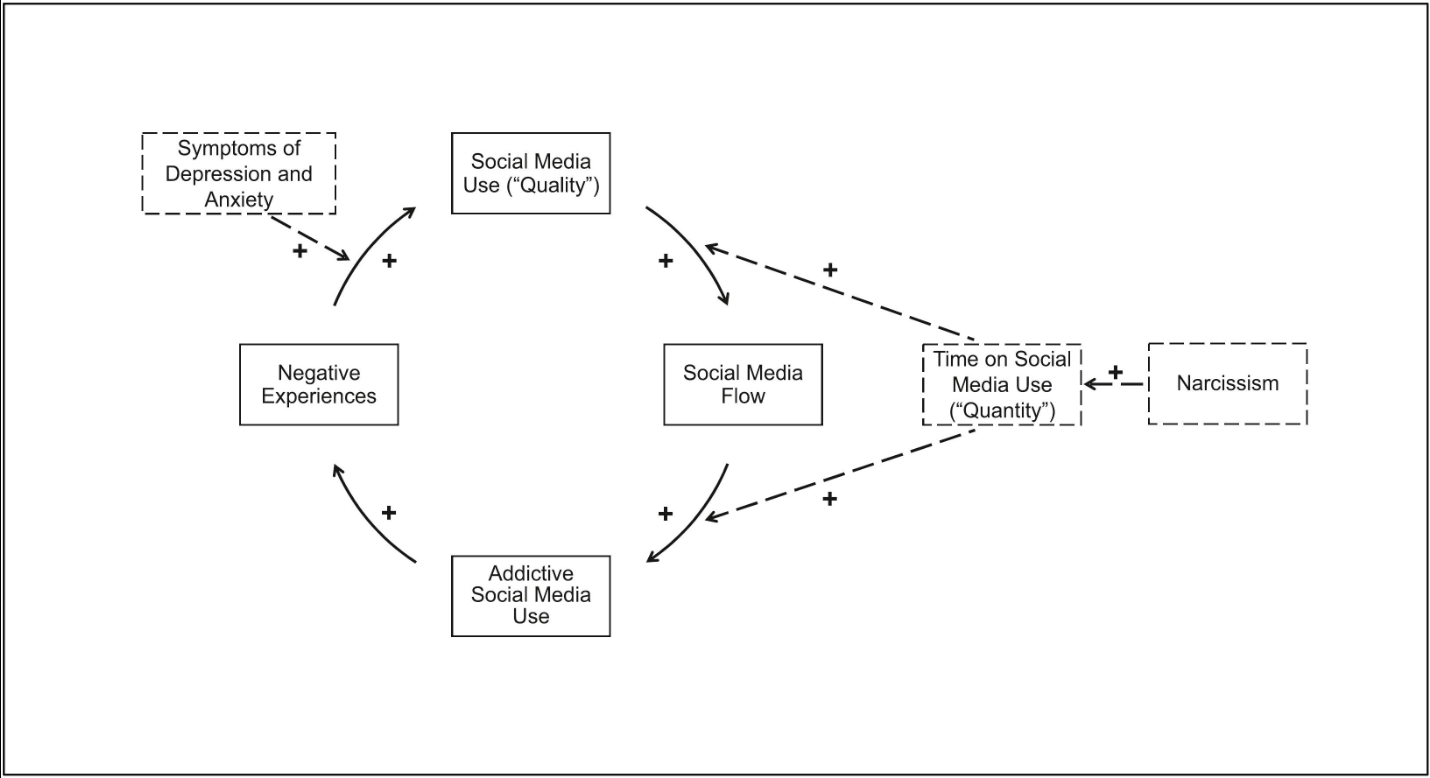
I also found a paper published by Dr. Julia Brailovskaia, a professor of mental health specializing in the relationship between mental health, personality and media use – especially relevant because it empirically compares social media use with "the interplay between the risk factors negative experiences caused by daily hassles and by unexpected global and traumatic events". I shouldn't have to point out that we are living through very traumatic times. The paper is titled, The “Vicious Circle of addictive Social Media Use and Mental Health” Model:
Addictive SMU (social media use) is described by six typical characteristics: salience (permanent thinking of SMU), tolerance (more and more time on SMU is required to achieve previous positive effects), mood modification (mood improvement by SMU), relapse (reverting to previous use pattern after ineffective attempts to reduce time spent on SMU), withdrawal (becoming nervous without SMU), and conflicts (interpersonal problems caused by intensive SMU) (Andreassen et al., 2016; Griffiths, 2005).
The paper also dissects the role of narcissism in SMU, which aligns squarely with my recent posts on the same subject:
Narcissism was one of the first personality traits investigated in the context of SMU (Buffardi & Campbell, 2008). Various studies reported a close positive link between narcissism and SMU (e.g., Błachnio & Przepiórka, 2018; Campbell & McCain, 2018). On SM, narcissistic individuals have many features to create a perfect self-presentation in front of a huge audience (Omori & Allen, 2021). The larger the audience, the more positive feedback including “Likes” and positive comments they can get (Brailovskaia & Margraf, 2019). Due to the lack of face-to-face contact, the online self-presentation can be planned and controlled accurately which is of specific importance for vulnerable narcissists due to their social insecurity and shyness (Fegan & Bland, 2021). Available research showed that the online activity of vulnerable and grandiose narcissists is very similar (Barry et al., 2019; Brailovskaia and Bierhoff, 2016, Brailovskaia and Bierhoff, 2020). As a consequence, all of them often receive the desired positive feedback on SM that satisfies their need for attention and admiration (Naik & Sherekar, 2022).
And back to how daily hassles and stressors increase harmful social media use:
Against the presented background, it can be concluded that negative experiences caused by daily hassles/unexpected global and traumatic events, SMU (dimension “quality”), and SM flow can serve as direct risk factors for the development and maintenance of addictive tendencies; symptoms of depression and anxiety, time spent on SMU (dimension “quantity”), and the personality trait narcissism seem to be indirect (moderating) risk factors.
The paper describes the "vicious cycle" that forms as a means of escape from increasing daily frictions,
A high level of addictive SMU is typically accompanied by a neglect of daily obligations due to a permanent occupation with the use that results in interpersonal conflicts. The conflicts enhance one's negative experiences offline that contribute further intensive SMU (dimension “quality”) as a form of escape.
And the author notes, grimly,
Notably, the long-term consequences of addictive tendencies will be visible only in the future. However, recent research has already identified enhanced levels of 1.) stress symptoms, 2.) insomnia, and 3.) suicide-related outcomes as potential consequences.
Readers aren't left wallowing, though. The paper also outlines protection strategies,
Against the presented background, the question arises how to protect more than five billion users of SM from the addictive tendencies and their negative consequences. Following available research, 1.) controlled and conscious reduction of time spent on SMU, 2.) physical activity, 3.) positive mental health (PMH), and 4.) mindfulness should be considered as potential protective factors that could break through the “vicious cycle”.
Social media addiction is a real addiction.
It shares core features with other addictions, including loss of control, developing tolerance, persistent urges, disruptions with real-world obligations, withdrawal symptoms, relapsing, and justifying continued use despite negative effects. Some psychology networks have responsibly taken the lead on designing treatments including cognitive behavioural therapy.
And while I found one watery paper on Nature.com claiming social media addiction is "overestimated", the mountain of research to the contrary state the opposite. It is very much a thing.
In fact, it appears social media addiction has been underestimated for so long it has entropied into an entire branch of mental health study all its own, one that researchers have broken into 25 different models designed to "identify theoretical perspectives and constructs that have been examined to explain the development of social media addiction" in a study titled, A review of theories and models applied in studies of social media addiction and implications for future research.
So we're actually past the window of, "is social media addiction real?" and now exist in, "which flav of social media addiction are we talking about?" Like any other addiction, there are multiple paths that lead us to it; formative emotional neglect, biological factors, environmental circumstances, psychopathy, conditioned social values – the difference with this addiction is that our entire culture enables it.
So what does it look like if we apply the progression of addiction as represented by the Jellinek Curve to social media addiction?
The Jellinick Curve is a conceptual model applied to addictions like drug dependencies and alcoholism, and as a framework it applies broadly to behavioural addictions as well. The graph below illustrates it in simple terms:
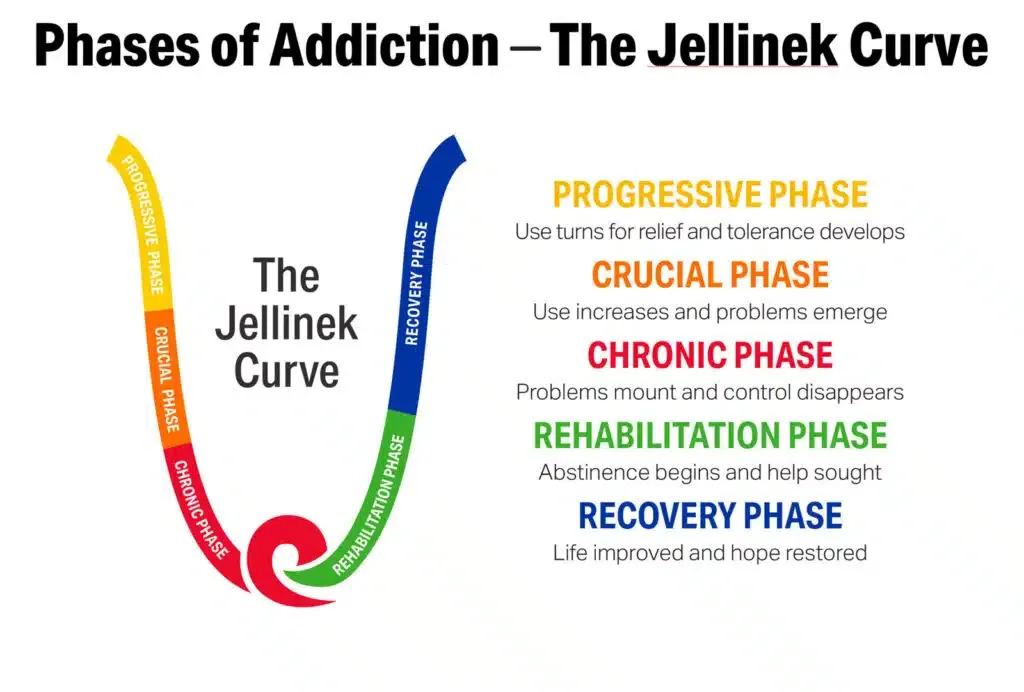
In the more detailed charts, the progression includes steps that have an uncanny resemblance to social media addiction. Scan through the bullet-point progression below and ask yourself how closely it applies to your relationship with social media:
Progressive phase:
- Occasional use
- Increase in tolerance, increase in use
- Onset of gaps in memory
- Feelings of urgency to use
- Feelings of guilt re: usage
- Usage bolstered with excuses
Crucial phase:
- Usage triggered by others' usage
- Decrease in ability to stop using
- Promises and resolutions to decrease usage fail
- Loss of interest in other activities
- Increase in daily stressors
- Increased feelings of anxiety and resentment
Chronic phase:
- Feelings of compulsivity and loss of control
- Onset of lengthly binges (feeling "sick" after extended usage)
- Retreating to spheres of chronic users
- Indefinable fears and constant worry
- Unable to initiate action to stop use
- Obsession with usage
- Vague desires for rescue via spiritual or systemic factors
- Complete defeat admitted
And just like other addictions, the steps to rehabilitation and recovery are extremely similar:
Rehabilitation:
- Learning the addiction is an illness
- Honest desire for help
- Stop using, change environment to aid habit changes
- Finding solidarity among recovering addicts
- Regular stocktaking of habits established
- Start of therapy
Recovery:
- Diminished fears of the unknown
- Appreciation for life's possibilities
- New hopes established
- Return of self-esteem
- Return of realistic thinking
- Desire for escape eases
- Healthy rest and sleep patterns return
- New circles of stable friends
- Hard facts faced with courage
- Increased emotional control
- Real-world application of values
- Increased economic stability
- Rationalizations recognized
- Contentment in sobriety
- Increased tolerance to triggers
- Therapy and mutual help continue
I consider myself a recovering social media addict, even though at this point no one would take such a claim seriously. "One year sober from social media" isn't something you post on social media, and it's sadly ironic that others' recovery from alcoholism includes regularly making such posts, leaning on one addiction to maintain sobriety from another. What a tangled web we're in.
And social media addiction doesn't come with "addiction lite" symptoms. They include cravings and obsessive compulsions, disjointed attention span and increased cognitive impairments, loss of memory function, neglect of interests and hobbies, withdrawal symptoms including anxiety and panic, hypersexual behaviour, increased risk behaviour, narcissistic behaviour, loss of empathy, polarized worldviews, depression, loss of semantic literacy, damaged self image, damaged self esteem – in the chronic stages, the products basically turn people into jittery narcissistic sociopaths.
And let's not forget social media is designed to be addictive, more explicitly so over the past decade. "Addiction" is a word with real meaning – people who use the word understand what it means and companies like Meta, X and TikTok are fully aware of what it does to users. Trapping users in their products is the whole goal, they aren't even hiding it anymore.
The past year has been my wonky, self-propelled journey into "sobriety" – I barely chose the path consciously, it's been a series of existential compulsions and I've often wondered whether this path was designed by my subconscious in a flailing pitch for cognitive survival. I wasn't in a good place. As a communications specialist, I'm someone who's been on the front line of social media systems for 15 years. Then there was grief from the loss of my coparent, and by extension my business, which of course took a cognitive toll, but the years-long clusterfuck of stressors and my persistent, growing inability to manage them was coming from somewhere else. I was losing memory quickly, feeling swelling panic often, and feeling less and less in control not just of my life but of my reactions and compulsions. I felt increasingly broken, disconnected, and gaslit by my reality.
A recovering drug addict isn't told to just keep using the drug "responsibly" in order to recover. A recovered alcoholic might be able to sit in a bar and not partake, but if they were required to partake "responsibly" – one drink for limited access, more drinks if you want to stay and participate in society – would anyone recover? No. This is what it feels like to be recovering from social media addiction. And because I work in communications, I feel especially trapped by it.
A mind that isn't only expected, but systemically obliged to partake in the substance causing its deterioration is doomed to continue down the path of chronic addiction. This is the increasing dissonance I feel. It kills my soul that my professional value is seen as less because I strongly prefer not managing social media. I can't engage. It literally damages my brain, it poisons my entire life.
The limited extent that I do engage is extremely disciplined and even Bluesky causes sensations of relapse – a jumbled brain, fractured task management, rising feelings of anxiety and hopelessness. It isn't just the news cycles, it's the systems delivering them. Bluesky's lack of ads and algorithmic manipulation feel safer to me, and I keep it on desktop to prevent mindless habits from forming. I post on Instagram once a week, downloading and deleting the app afterwards each time. I don't save any passwords for social media apps in my phone – retrieving them is laborious each time and I keep it that way as a relapse mitigation strategy.
We don't have a formal diagnosis to validate the illness of social media addiction, because if we did, our entire economy would collapse through lawsuits and medical exemptions.
And when everyone around you is high, fully enabled by their workplaces, social circles and "online communities", where does recovery even begin? When every institution is a pusher, every pal an enabler, what does a healing path even look like?
Eventually I'll find my offline people, but of course, they're offline, in the wild, meanwhile I'm hustling to rebuild my life in a new place. I don't yet have the time required to go out and cultivate real world relationships. I don't even know what they look like, almost no one operates in a completely offline mode anymore. I feel so much anxiety about interacting with other addicts who are either completely unaware of their addiction and would belittle me if I tried to explain it, or who acknowledge they're addicted and flippantly laugh it off. It's a joke to everyone, meanwhile their mental health and relationships are fracturing and they don't know why. They just keep parroting the content and as the world gets harder they lean into their vicious online cycles to cope, becoming less empathetic, more narcissistic, and more frantically helpless.
The difference between my "sober" self – the difference in how my brain feels – my cognitive health, my self image and self worth, my capacity for empathy, how differently I experience time – the difference between myself now and my past self who was coupled with those systems... it's stark. That starkness is what scares me the most as the world gets harder, as the chaos increases and more people retreat into the apps, doubling down on what is an irrefutably destructive addiction.
What happens when an addict can't escape the chronic phase of addiction?
A living hell? Persistent feelings of helplessness and hopelessness, and as shown by the research cited above, increases in suicidal thoughts, which I don't need to describe the end stages of.
And let's not forget about rising cases of digital dementia and spikes in early onset dementia linked to excessive screen time, which I've talked about on this blog multiple times.
And what really bothers me is some of the "studies" claiming social media increases wellness for people who are at risk of dementia – so many people glaze over those shallow pieces and reassure themselves that they're okay, not noticing the lack of detail regarding which platforms were used in the studies, no factoring for the exploitative evolution of algorithms or the hard proof that short video addiction causes cognitive decline – not to sound conspiratorial but "social media is good for you actually" is NOT TRUE. Maybe there was a case for that position before 2020, but it's long since been erased. Even anecdotally I can list at least ten examples of cognitive decline in family and friends within my circles related directly to their use of social media. It's REAL and it's happening right in front of us while we're being told not to believe our eyes or lived experiences.
I just... I don't know what the answer is. On an individual level, I have exit strategies and flowers. My kids are deeply aware – my eldest doesn't use social media at all and my youngest is weaning off of TikTok, but still uses Youtube, which we keep checks on. There are specific friends in my circles who I think of when I write these pieces, hoping they'll read the words and something will click. I don't think calling someone to tell them you think they're a spiralling addict would go very well. The call has to come from inside the house, but I keep writing anyway.
Otherwise I feel a profound sense of grief when I think about the trajectory we're on. AI is supercharging the effects of social media – cognitive offloading isn't just a trending term, it's real, it's still happening, and until our culture can formally acknowledge digital addictions as valid disorders/diagnoses, accessible paths to recovery simply won't exist. Find me a therapist or a councillor who isn't addicted to social media, who wouldn't minimize the addiction and who could point to offline pathways for support. Show me a flourishing offline community, for that matter.
I can't just pretend this affliction doesn't exist. I can't not see it when I look back at who I was, and when I see the same shadows of compulsive and disordered behaviour in my circles. It's a real illness, a pandemic of its own, and our devices are only locking us in further.
The simplest steps a person can take – the things I did that gradually led me to a place where healing became possible – are:
- Acknowledge the severity of the addiction. It's real. It's causing real damage to your brain. You need your brain.
- Delete accounts on any apps you don't critically need. This used to be a simple thing but they've made it more annoying than ever to do. Start untangling now and just keep at it.
- Begin downloading data from the apps you plan to leave. Keep a checklist and follow it.
- Move remaining apps to your desktop. Make passwords inconvenient but secure (you don't want to lose access to your data until you have it stored in your own system).
- Build back your navigation abilities by weaning off map apps. This rebuilds your spatial memory while also breaking dependence from your phone.
- Pick a spot out-of-sight in your house to leave your phone, and challenge yourself to go one hour, then two, then three etc without it.
- Let people know when you won't have your phone on you. I leave it at home if I'm only leaving the house for a couple hours, and I let my kids know when I won't have it on me.
- Build back the habit of offline reading, reading a mix of fiction and nonfiction that challenges you to learn. I swear to god every page I read reactivates a new synapse.
- I take Lion's Mane mushroom daily, and phases of psilocybin microdosing can be a nice cognitive refresh too.
That's as far as I've got in my recovery. Ngl it's lonely. Not very many people will empathize or understand why cultivating offline habits are so critical to you, but the further along you get, the more stark the difference becomes between the "real world" and the synthetic systems so many are coupled with.
It isn't currently possible for anyone to be fully offline, and I've tried to make peace with that. But social media is a different sort of online that we still have some agency over. It's critical we protect that agency while we can. This feels like a feeble ending to an emotionally charged piece, but I don't know how many more ways I can make this point. Save yourselves. It's important.