Applying the model of community radio to decentralized social media
I've been trying to find a solution to the problem of social media. Over a year ago I designed a model I thought might work – a tiered networking platform that offered free functionality to individual users, paid profiles to businesses and institutions, and founder/investor shares to arts and cultural foundations. My brother, a data science program manager, partnered with me as I fleshed out the problem statement and prepared funder proposals. I framed it as, "a social-impact platform founded on the tenets of community-building, reciprocity, and social responsibility." And because I still think it wasn't a terrible idea, here's a bit more from the business proposal:
In this model, the platform is owned and stewarded by trusted cultural foundations and governed by representatives of the cultural sector. We believe these institutions and foundations are best suited for the role, as they have historically upheld and nurtured our cultural communities.
Surplus revenue generated by the platform will be held by its steward foundations and dispersed back to the community via granting streams. Community-generated data will be “reinvested” back into community via analytics dashboards designed to support organizations and small businesses in making strategic operational decisions.
We are building an online ecosystem that embraces reciprocity and community health. No data is monetized, no advertisers are required. The key stakeholder groups in this model are “Founders”, “Builders”, and “Socializers”:
“Founders” are the investor foundations and board directors who share our vision and care deeply about the health and vibrancy of our communities. Representing community interests across sectors, Founders steer the growth and evolution of the platform, ensuring every step is for the greater social good.
“Builders” are the “social care” organizations; impact-driven nonprofits, museums, galleries, theatres, educational institutions, charities, associations, community hubs, small businesses and societies. Builders invest in their communities through tiered, paid plans that include reach and engagement features exclusive to Builder members.
Through data dashboards, Builders access and apply the data their communities generate, allowing them to make smarter, more community-focused strategic choices.
“Socializers” are patrons, artists, creators, students, advocates, donors, professionals, family and friends. Socializers participate in, amplify, support and strengthen their communities.
Socializers join the platform for free through invites from Builders and other Socializers.
From data architecture to carefully considered UX, UI, and strategic engagement features, this model reinforces critical community-building behaviour and re-teaches audiences what it means to exist in a vibrant cultural community.
It's an idealistic project, sure, but it was the best antidote to Meta I could think of at the time. My conversion strategy was designed in phases and started with 'Builder' buy-in, who would then hypothetically (consensually) convert their mailing lists into the platform (email marketing was a Builder feature), coaxing new users in through clean community events management. From there, users would expand their social spaces through "pro-social" incentives like creative mini games and creator tools. The entire model was centred on culture-building and amplifying the richness of the arts. Maybe there's still a path forward for it, but ultimately we couldn't convince potential funders why users would ever want to leave Meta products. I did a lot of research trying to highlight Meta's dangerous monopolistic hold on our communities, and conducted surveys where every respondent shared some variation of "I feel trapped on Insta/FB", but without risking my professional legitimacy by dipping into my existential fears about where commercial social media leads us as a society, we just couldn't make the case strong enough. At the time, the urgency wasn't palpable for them. It still isn't.
I think Meta products are deeply corrosive both to localized community health and individual users' cognitive free will. Maybe the problem statement will strengthen on its own as time passes and the unseen costs of Meta platforms becomes clearer.
I've shared in previous posts, my research for this project led me to an awareness of effective accelerationism and its intertwinement with the Trump regime, and by extension the schemes of the hard-right parties of Alberta. This, plus plenty of other existential challenges within the province and Western Canada led to me yeeting my family out of Alberta as quickly as I could manage.
I started working in communications because I was intuitively well-tuned to flows of information and pattern-recognition. My neurodivergent mode adapted easily to social media, starting with MySpace and growing from there. I love having fun all the time, but in person I'm a bit strange and hard for people to categorize. Art school was the last phase of my life where I didn't feel like an alien, and as I moved through parenting and pursuing my passions, social media offered opportunities for expressive parallel play, dancing in my own thoughts while inviting others in. This led to easy organic engagement, which led to observing collective human behaviour and the growing feeling that things were going terribly wrong. It was only recently that I found a behavioural science glossary that finally opened my world to the terms defining the phenomenas I've been observing for two decades. I hadn't studied behavioural science before, I was too busy strategizing around it in my work. The phenomenas will continue to evolve as our technologies do, but knowing things like self categorization theory exists at least helps me feel less crazy when I see people rigidly classify themselves online, voluntarily homogenizing themselves and making their data that much easier to harvest. This is one behaviour among many that's been perpetuated and amplified by social media.
I loved online socials for a long time. I thrived on the platforms, and the real-life communities who supported me in those spaces were foundational to my survival as a poverty-raised creative oddball. My communications career extended beyond my workplaces and the channels became more like an orchestra, or even a garden. A maestro and a gardener are similar in a lot of ways; coaxing here, calming there, conducting the chaos into something resonant and beautiful. And not just social media – the entire web of communications was my sparkling playspace for a long time. News media, websites, podcasts, radio shows, radio plays, writing, editing, publishing, content creation, videos, photography, performing – from writing key messages to delighting a rapt audience, communications is a field I've found endless, substantial joy within.
Which is why it's been crushing, on a personal and foundational level, to watch those infospheres become so corroded and exploitative. The spaces we trusted our social fabric to have grossly desecrated that trust, knowingly, systematically and strategically. Our localized communities are withered and weakened. People's cognitive functions are waning, while the sunk cost of offloading their literal memories onto exploitative platforms prevents them from migrating somewhere safer. Companies like Meta, TikTok, X, even Tumblr – CEOs who've all publicly pledged fealty to the most overtly fascist regime of our time – have chained our social psyches into believing this is normal. Most users can't even remember living without these spaces, because their memory functions are literally atrophied. This "normal" is wrong, yet everyone blindly accepts it as the way things must be. As though a capitalist patriarchy wasn't enough, now we have a digital capitalist patriarchy. An entire digital dimension at the mercy of techbro capital.
This is an existential emergency, and every time I let myself look at it I feel like I'm losing my mind. Even as I write this, my heart is racing, again. I feel powerless as I watch generations of bright minds sink into the homogenizing depths of commercialized "community", sedated, unquestioning, utterly docile.
And I cannot tell you how much it kills me to remove myself from the online social spaces I once enjoyed freely and felt so much love within. Having observed their procession into pure exploitation, my values simply don't permit me to normalize them anymore. I'm just barely recovering from the cognitive cost of algorithmic atrophy, my memories are finally beginning to float to the surface bringing a richness I thought I'd lost access to. The sensorial reflections, echoes of feeling, hushed waves of total recall – through my detox journey I've realized those spaces don't only make us feel lonely through their social silos, but they steal the richness of our past. How much more alone does a person feel when they can't access comforting memories of past gatherings, warm embraces, raucous adventures, tender conversations – when all those memories are held captive by corporations, when a person can't just sit in their own thoughts and pull from those bright archives on their own – can we see the poison of it? Please?
Enshittification, perhaps the most irritating term of this decade, is only a fraction of what online spaces are forcing onto us. It doesn't begin to describe the risks to our cognitive and social agency. We need to find a path through this problem, or we are fucked. I can't say it any gentler than that.
So where does community radio come in?
If my community-led social media model described above isn't the answer, I've got another one gelling, and maybe there's even room for the two ideas to merge. I haven't fully fleshed it out yet, and this is a blog, not a pitch deck, but I think there might be a path forward within the model of community radio.
I worked for a community radio station (CJSW 90.9FM) for a couple years back in the 2010s. Community radio is a goddamn delight when steered by genuine community values, and my time with the station was an incredible gift in understanding the dynamics of real community. The station's programming ranged (and still ranges) from punk, experimental, spoken word, metal, indie pop, soul, hip hop, rap, electronica, and a wide range of international programs representing the city's multicultural communities. Within each of those programs, all genders and sexualities are welcome, and hosts cover a diverse spread of interests. The station's umbrella makes room for everyone in the margins, because the margins are where real communities thrive.
The nature of community radio is different from the podcasting sphere, though it does often dabble within podcasting by offering prerecorded versions of its programming. But the world of podcasting has largely followed the same homogenized model of social media, categorizing and siloing community according to special interests rather than locality. This is the wrong direction – siloed communities scattered across geographies are not going to help us contend with what's ahead, they will only widen our social divides.
Locality is what real community hinges on, where each community member is a tactile stakeholder within their shared location, and thus contribute for the benefit of the collective. Community radio amplifies this dynamic through its locally-focused business model – local events, bands, venues – and the stations' advertising mandates elevate independent businesses only, which buffers them from commercial interests. In fact, most community radio stations risk losing funding by bending to commercial influence. Their entire existence is built on amplifying local community.
From Wikipedia:
the CRTC requires community stations to
-facilitate community access to programming;
-promote the availability of training throughout the community; and
-provide for the ongoing training and supervision of those within the community wishing to participate in programming.
It also requires stations to offer diverse programming that reflects the needs and interests of the community, including:
-music by new and local talent;
-music not generally broadcast by commercial stations;
-spoken word programming; and
-local information.[1]
And notably,
Community radio has had a significant presence in Native communities in the Canadian north, with over 60 community radio stations in Native communities in the Canadian north by 2016.[3] A large part of the impetus for community radio in these communities was the challenge of keeping Native languages and cultures thriving. In 1973, the CBC began broadcasting southern Canadian and American television and radio into small northern communities, which many saw as a threat to the survival of their language and culture. Subsequently, many northern Native communities began their own community radio stations.[6] This later accelerated with the implementation of the Northern Native Broadcast Access Program in 1983.[3][7]
Community radio emerged in Canada in the 1970s and grew across North America in the 1990s as a response to overwhelming commercial broadcasting lobbies. Commercial stations held semi-monopolies and really didn't want "micro radio" to exist, but low-power FM frequencies were so accessible to local broadcasters, community stations eventually gained momentum and government support. But the existence of community stations still relies heavily on funding drives and loyal community support. For the most part, these stations have weathered the digital transition fairly well, with the exception of 2023, when Meta decided to ban news outlets for Canadian users of Facebook and Instagram, which extended to the accounts of community radio stations. Luckily, loyal radio listeners are reachable via FM airwaves, and the stations I'm aware of have held relatively stable footing since that time.
The next challenge, of course, is neofascism. Hyper-capitalist governments, whether the American technofascist regime or Canada's cold, militaristic corporate neoliberals, are systematically rescinding funding for most publicly-funded entities, and I'm sure community radio, as most registered nonprofits, will feel that pinch in the near future. This is where I think the community radio model could be applied, even iterated, towards a new social media framework.
A loose picture of a new social media model
The accessibility of low-power FM frequencies made community radio possible in the face of powerful commercial lobbies, why can't decentralized, open-source protocols function the same way for community-focused social media?
Many such platforms already exist, but the general public's gap in digital literacy makes them inaccessible and less viable as real rivals to Meta. I also think the critical flaw of those platforms, and why they will never adequately respond to the urgent needs of community, is they are still working within a framework dictated by capitalist-driven social media, that is – globalized community.
We can't preserve our localized social fabrics if we keep trying to build them within a paradigm of globalization.
Shall we review what globalization is? It's a capitalist process, begat by the Industrial Revolution wherein capital models blur geopolitical borders and stretch across multiple national economies. It accelerates environmental degradation, propels labour exploitation, increases wealth inequality and concentrations of capital, causes chronic geosocial displacements, and perpetuates ongoing erosion of local economies.
So why would we think any platform designed through that paradigm would benefit our localized or marginalized communities? Not only do they not benefit them, they actively erode them. When institutions choose to add value to such platforms by contributing their brands and participating in the machine of Engagement, they are unknowingly aiding the degradation of the very communities they wish to support.
The answer isn't, "get better at navigating the algorithms", "make better content", or, "pay for more ads and boosts", those only take us farther down the dark path of corporate fascism. The answer is to build something different, as far from the globalist framework as possible.
From here I see two paths:
- A movement that hybridizes community radio and social media.
Funnelling funding and designating resources for the express purposes of extending community radio services into online social networking functions via open-source protocols.
Mandates, localized focus, and communities served would not change, they would be extended through the medium of open-source protocols.
Community radio station's apps (many already have apps) would function as a social media sites that also stream radio programs. (this also sends a blow to exploitative streaming services like Spotify) - Social media platforms built referencing the models of community radio.
Localized user bases, localized content, region-specific event management.
Essentially a user would log in and see their actual, local community. Users could customize their feeds according to filters based in hobbies, interests and even relationship status.
Everything would be public, terms of service would frame the platform as a community square.
Managed by central teams, founded similarly to how community radio stations were built in the early days. I know that sounds simplistic and vague, but again, this is a blog. If it was something we were going to do for real, we'd obvs hammer out the details.
In both those cases I also imagine a "dial" app that would consolidate the platforms into one navigational UI, so users could essentially "change the channel" between localities. There would also be a function that allowed coordination between localities, like sending flares, alerts, calls for assitance, etc.
There could also be "global groups" functions for people who've built up relationships with people in other areas, but that would be a secondary feature, not the primary UX like current social platforms. The idea is to push back against globalist capitalism while still acknowledging there will be a process of untangling ourselves from it.
My brain will keep chugging away at this
I can't help it. I'll keep collecting the puzzle pieces and adding them to my vision of what could be. Communications used to be the nervous system of our information ecosystem, the fidelity of our flows of information is what we're supposed to care about. I know the chances of any of these ideas becoming real is super slim. I don't have the resources, and I refuse to work with VC. But I've put ideas into the aether before that led to cool things down the line. These are high entropy times, who knows.
What concerns me most is that our flows of information are being hijacked, defiled, polluted. Our response can't be to just accept these new, mangled limitations, normalize them, and contribute value to them by giving them our brands, our energy, our minds, and our communities. I absolutely refuse that path, and it may end up that I ultimately just find myself working with flowers, seeking a "ground up" solution from a completely different angle. But I can't just shrug and say "oh well". We can do better, I'm sure of it.
And to end this on a lighter note, here's a radio play I produced during my time with CJSW. I'm a big Star Trek TNG fan, and I had always wanted to produce a sci-fi radio play. I only got halfway through the "season" (my production schedule was pretty chaotic as I balanced it with work, parenting and standup comedy), but listening to it again, I'm thinking about how due the podcasting sphere is for art and fun. What about podcasted radio plays that convey difficult topics, heady research, political themes, etc? How fun would that be?
Update: This was neat to come across so soon after publishing this piece:
 Kelly Roegies
Community radio isn't the same as government institutions but there are public sector/nonprofit crossovers that apply. And because community radio tends to lean on niche broadcasting tech specialists anyway, I wonder if an open-source procurement model would translate easier for them. Like I wasn't on the technical side of the radio model while I worked for CJSW (though I did briefly go out with their tech years later, maybe I should tap him about this), but this seems like something small stations already do re: tech procurement:
Assess protocol governance health as part of standard due diligence: who maintains the protocol, how breaking changes are handled, and how concentrated influence over its direction is. When procuring a vendor, prioritise suppliers who actively participate in the ecosystem by contributing upstream, engaging in governance, and coordinating on security. When building in-house, factor governance participation and protocol literacy into staffing and resourcing decisions from the start.
And because community stations aren't as rigidly operated as other public sector institutions, I wonder if the adoption process could be easier for them.
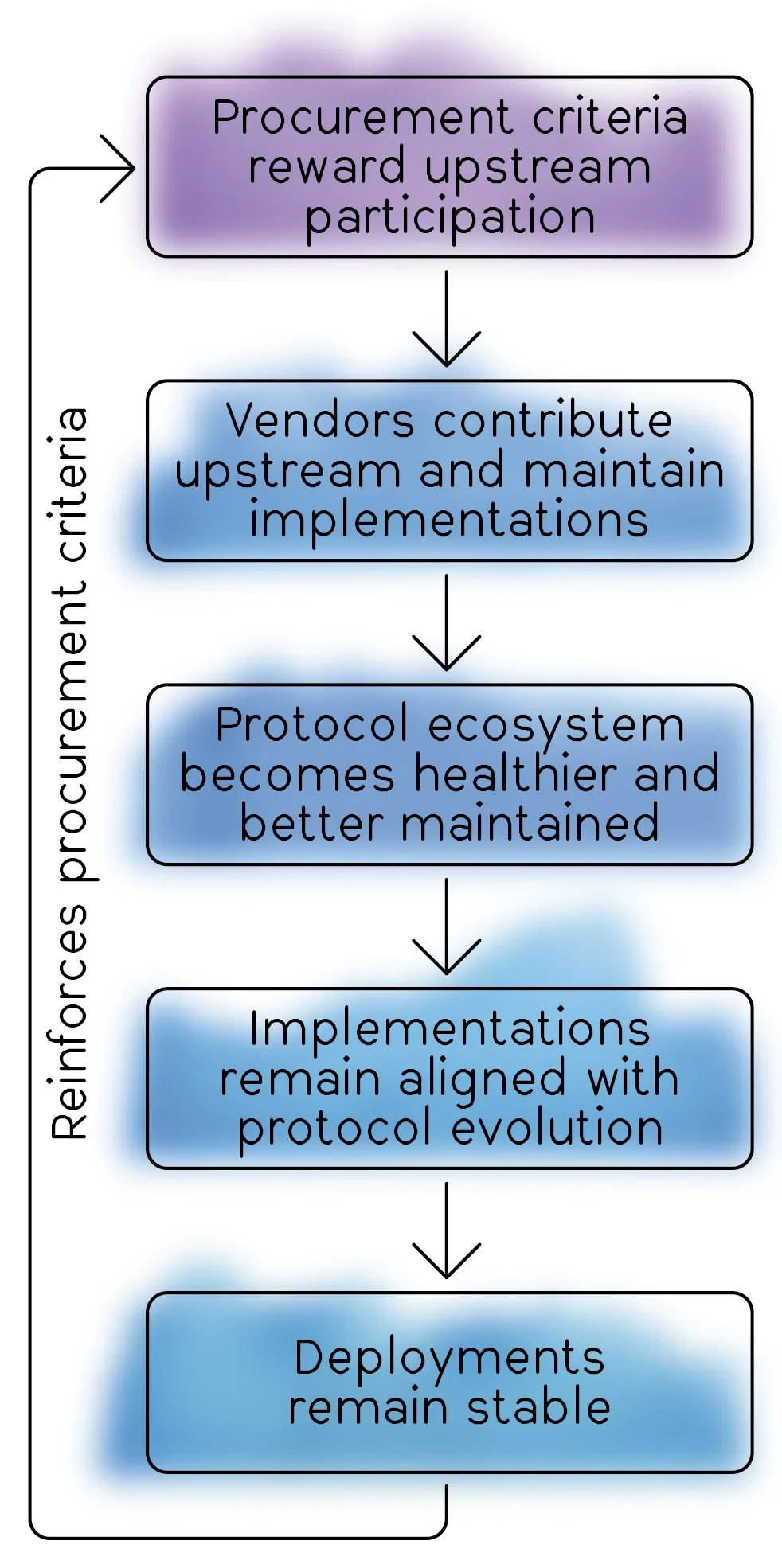
Open protocol adoption by governments will continue. The pressures behind it are structural: the political will to reduce dependency on digital infrastructure controlled by big tech companies outside their jurisdiction, legal requirements for cross-border interoperability, and the economic advantages of building infrastructure on open protocols rather than each institution developing its own proprietary stacks.
The question is whether the institutions involved understand the nature of that commitment. They are not simply buying a product. They are stepping into agovernance process that existed before their deployment and will continue long after their contract ends.
The institutions that invest in that relationship – that send someone to the working group, contribute to the specification and treat the protocol community as a constituency rather than a supplier – will end up with something no procurement process can deliver: infrastructure that grows with them, not against them.
I think I'll need to dedicate more time to this, because it feels like it's got legs but because I'm not especially literate within open protocol technology, I might be skipping along and making too many assumptions.